How to Choose a Facelift Hospital in Thailand: 8 Factors to Consider

Changes in facial firmness, lower-cheek definition, and neck contour may lead some people to explore facelift surgery. Choosing where to undergo treatment involves more than comparing prices or looking at before and after photographs.
The surgeon’s qualifications, the surgical setting, the proposed procedure, and the arrangements for recovery all deserve consideration.
At Asia Cosmetic Hospital, we encourage people considering facelift surgery in Thailand to understand their options and prepare questions before making a decision. This guide covers eight factors that can help make the consultation more informative.
1. Check the Surgeon’s Qualifications
Start by confirming the identity and qualifications of the surgeon who will perform the operation. A consultation with a clinic representative should not replace a discussion with the treating surgeon.
You can use the Medical Council of Thailand’s physician verification website to check a doctor’s registration information.
During your consultation, ask about:
-
Relevant specialist qualifications.
-
Experience performing the proposed facelift procedure.
-
Experience treating concerns similar to yours.
-
Who will perform the surgery and provide follow-up care.
Asia Cosmetic Hospital’s facelift guide introduces Dr. Thanakom Laisakul in relation to its facelift services. When arranging an appointment, confirm which surgeon will assess you and perform your procedure.
2. Verify the Healthcare Facility’s License
Confirm the name and location of the facility where surgery will take place. The consultation location and the operating facility may be different, so both should be clear before booking.
Information about healthcare facilities can be checked through Thailand’s Department of Health Service Support.
A facility license is one part of the assessment. You should also ask about its surgical facilities, staffing, emergency arrangements, and postoperative care.
Useful questions include:
-
Where will the operation take place?
-
Is that facility authorized to provide the planned treatment?
-
Will an overnight stay be required?
-
What arrangements are available if additional medical care is needed?
3. Ask About the Operating Room and Emergency Support
The surgical environment is an important part of treatment planning. Ask how the facility manages infection prevention, equipment maintenance, patient monitoring, and emergencies.
Asia Cosmetic Hospital’s published guide describes the use of a positive-pressure operating room. This is one feature of the operating environment; it should be considered alongside the facility’s broader infection-control procedures and clinical systems.
No operating-room feature can eliminate every surgical risk. The care team should explain how it prepares for and responds to potential complications.
4. Understand the Anesthesia Plan
The anesthesia approach depends on the procedure, your health, and the surgical team’s assessment.
Before surgery, discuss your medical history, allergies, medications, supplements, and any previous reactions to anesthesia. Ask who will conduct the preoperative assessment and who will monitor you during the operation and early recovery.
Asia Cosmetic Hospital’s guide describes anesthesiology support as part of its surgical care. Your consultation should clarify the arrangements for your individual procedure, including:
-
The proposed type of anesthesia.
-
Any required preoperative examinations.
-
Monitoring during surgery.
-
Care during recovery from anesthesia.
Follow the treating team’s instructions about medications and preparation.
5. Choose a Treatment Plan Based on Your Facial Concerns
A facelift should be planned around your anatomy and goals. People with similar ages may have different patterns of tissue laxity, skin quality, and facial structure.
Areas to discuss may include:
-
Lower-cheek sagging.
-
Reduced jawline definition.
-
Loose skin around the neck.
-
Brow or forehead concerns.
These concerns do not necessarily require the same procedure. A facelift may also have limitations in addressing skin texture, pigmentation, fine lines, or volume loss.
At Asia Cosmetic Hospital, the consultation is an opportunity to clarify which areas a proposed operation would address and whether a separate or additional treatment should be considered.
6. Understand What the Technique Names Mean
Terms such as “mini facelift,” “full facelift,” “SMAS facelift,” and “endoscopic lift” describe different aspects of surgery. They are not interchangeable.
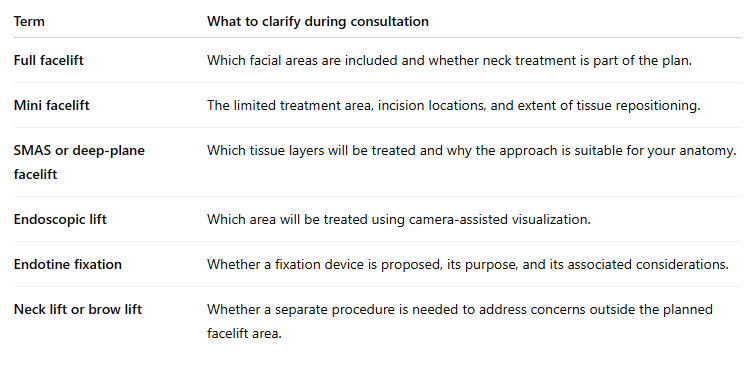
A technique name alone does not establish suitability. Ask the surgeon to explain the proposed approach in terms of your concerns, expected benefits, limitations, and risks.
7. Discuss Incisions, Scars, and Realistic Outcomes
Incision placement varies according to the procedure. Incisions may be placed around the ears, within the hairline, or in other locations appropriate to the treatment plan.
Although surgeons plan incisions carefully, scars are an expected consequence of surgery. Their appearance depends on factors such as the incision location, individual healing, and postoperative care.
Before-and-after photographs can support a discussion, but they cannot predict your result. When reviewing examples, ask:
-
How long after surgery was the photograph taken?
-
Were additional procedures performed?
-
How similar was the patient’s starting condition to yours?
-
What changes would be realistic in your case?
Facelift surgery also carries risks, including bleeding, infection, poor wound healing, unfavorable scarring, asymmetry, changes in sensation, and nerve injury. These should be discussed before consent.
The aim is to understand the likely improvement and its limits. Surgery cannot stop the aging process or guarantee a particular appearance.
8. Review Recovery, Follow-Up, and Total Costs
Recovery planning should begin before the procedure. Ask about the expected early recovery period, follow-up appointments, wound care, and restrictions on work, exercise, and travel.
Initial recovery is different from complete healing. Swelling, scar maturation, and the settling of results may continue after you resume some daily activities.
Before booking facelift surgery at Asia Cosmetic Hospital, request a clear explanation of:
-
What the quoted price includes.
-
Surgeon, anesthesia, and facility fees.
-
Required examinations and medications.
-
Any hospital stay.
-
Routine follow-up appointments.
-
Potential additional costs if further care is needed.
If you are traveling to Thailand, discuss how long you should remain near the hospital and how follow-up will be managed after you return home.
Questions to Bring to Your Facelift Consultation
Preparing a short list of questions can help you compare treatment plans more meaningfully.
-
Which procedure do you recommend for my concerns, and why?
-
Which areas will it improve, and which will remain outside its scope?
-
Who will perform the operation and provide follow-up care?
-
Where will the incisions be placed?
-
What are the main risks in my individual case?
-
When might I return to work, exercise, and travel?
-
What is included in the price, and how can I contact the team during recovery?
Explore Facelift Services at Asia Cosmetic Hospital on ArokaGO
Choosing a facelift hospital in Thailand begins with understanding the proposed care. Surgeon credentials, facility information, an individualized treatment plan, and accessible follow-up all contribute to an informed decision.
To learn more, visit the Asia Cosmetic Hospital provider profile on ArokaGO. You can explore the hospital’s information and request a consultation to discuss your concerns, suitability, treatment options, and estimated costs.
This article provides general educational information. Procedure selection, risks, recovery, and expected outcomes require an individual medical assessment.
References
-
Asia Cosmetic Hospital. (n.d.). Facelift clinic guide. https://asiahospitalsurgery.com/facelift-clinic-guide/
-
Asia Cosmetic Hospital. (n.d.). Facelift. https://asiahospitalsurgery.com/facelift/
-
American Society of Plastic Surgeons. (n.d.). Facelift risks and safety. https://www.plasticsurgery.org/cosmetic-procedures/facelift/safety
-
Medical Council of Thailand. (n.d.). Physician verification. https://checkmd.tmc.or.th/
-
Department of Health Service Support. (n.d.). Healthcare facility information. https://hosp.hss.moph.go.th/
Aaia Cosmetic Hospital
Share this article
More Articles
Discover more insights on health care and medical tourism.

Top 4 Romantic Beachfront Resorts in Samui with Private Pool Villas
Discover the top 4 romantic beachfront resorts in Samui with private pool villas. Explore luxury retreats like Melati Beach Resort & Spa and Chaweng Regent.

MTF Gender Affirmation Surgery at Asia Cosmetic Hospital: Options, Preparation, and Recovery
Choosing male-to-female gender affirmation surgery involves more than selecting a technique or scheduling an operation. Understanding the potential outcomes, limitations, risks, and aftercare can help you consider whether treatment fits your goals and circumstances.

9 Plastic Surgery Hospitals and Aesthetic Centers in Thailand to Explore on ArokaGO
Finding a plastic surgery hospital in Thailand often begins with a procedure in mind: a facelift, breast lift, rhinoplasty, or body contouring. Choosing where to receive treatment, however, involves more than reviewing photographs and comparing prices. Surgeon qualifications, treatment options, the actual treatment location, and postoperative care all deserve attention.