Mesenchymal Stem Cells Treatment Guidelines for Degenerative Diseases

The first clinical trial utilizing MSCs derived from the patient’s bone marrow was conducted in 1995 (Lazarus.,1995). MSCs was infused into the blood stream of the patient recovering from bone marrow transplantation to enhance blood flow recovery. Since then, MSCs have been applied more for therapeutic use. According to the public clinical trials database at http://clinicaltrials.gov (2020), it shows that MSCs have been widely applied in clinics as a treatment for numerous degenerative disorders. Numerous clinical trials have been conducted to test the feasibility and efficacy of MSC-based therapy ranging from evaluating the safety of MSCs (Phase 1), increasing the number of patients tested (Phase 2), and confirming the successful trials on large groups of the patients (Phase 3). As shown in Figure 1, more clinical trials using MSCs for Neurological, Joint, and Cardiovascular diseases are being conducted than other diseases.
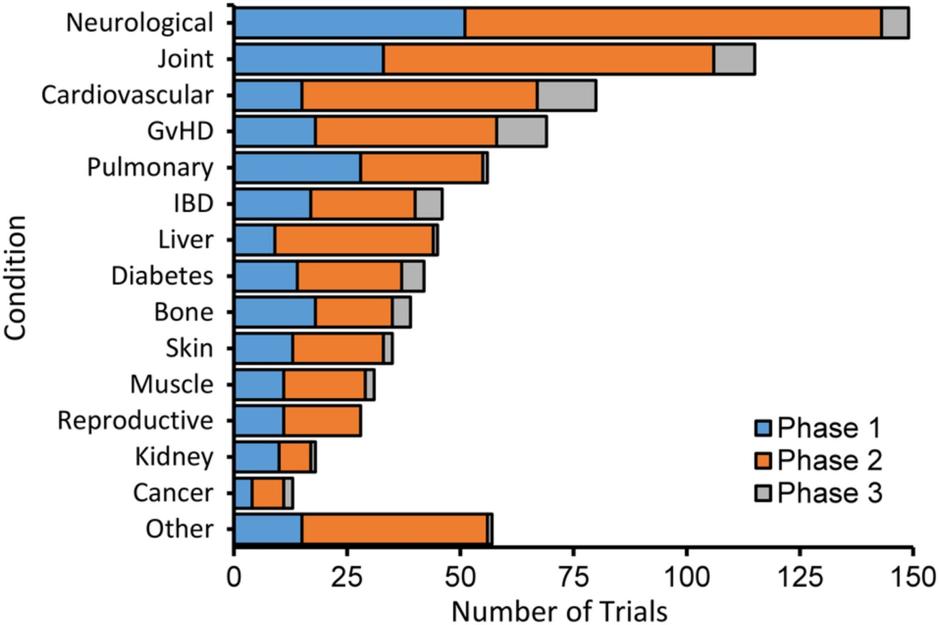
Figure 1. Mesenchymal stem cell (MSC) clinical trials by disease category subdivided by phase. (Kabat M et.,al, 2020)
MSCs for therapeutic applications can be derived from various sources. Bone marrow (BM) was the first isolated source of MSCs, and they have been used in several clinical trials. To date, MSCs can be obtained from different sources including umbilical cord (UC) and placenta and more clinical trials on MSCs derived from UC and placenta have been conducted. Compared to bone-marrow-derived MSCs, placenta-derived MSCs (P-MSCs) and umbilical cord-derived MSCs (UCMSCs) are known to be easier to isolate and culture.
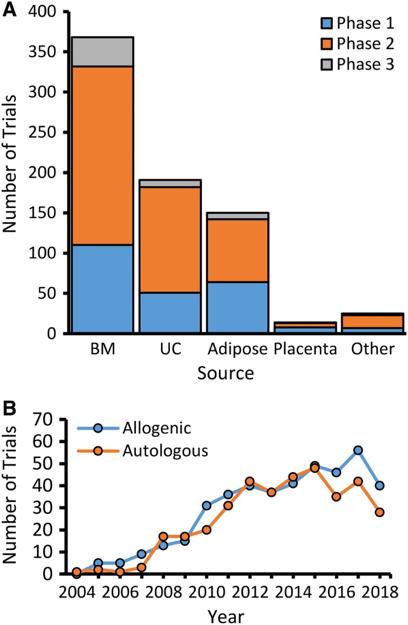
Figure 2. (A) Number of clinical trials using MSCs from different sources. (B) Number of clinical trials using different MSC types in each year. (Kabat M et.,al, 2020)
At present, the study of replacing autologous MSCs (auto-MSCs or patient’s own MSCs) with allogeneic MSCs (allo-MSCs or MSCs from other suitable donors) are increasing. Apart from unwanted immune-responses or transplant rejections, the reasons for the poor long-term efficacy of auto-MSCs may be as follows. The preparation procedure including cell culture, expansion, and storage are more complicated than allogeneic alternatives and harvesting bone marrow is easy to cause injury and complications. (Shariatzadeh M et.,al, 2019) Moreover, the challenging issue of auto-MSCs also includes a low proliferation capacity which may result in a limited number of MSCs. With these reasons, more applications of allo-MSCs have been used than auto-MSCs as shown in Figure 2.
Reference:
Stem cell for life Mesenchymal Stem Cells Treatment Guidelines for Degenerative Diseases
Stem cell for life
Share this article
More Articles
Discover more insights on health care and medical tourism.

Insulin Resistance and Chronic Inflammation
The Overlooked Starting Point of Chronic Disease

Melatonin: the key to sleep
Melatonin is an essential hormone that plays a direct role in the body’s circadian rhythm, particularly in regulating the sleep-wake cycle. It has a significant impact on overall physical and mental health.

Hantavirus
Hantavirus is a group of viruses transmitted by rodents, particularly rats and mice, which can cause severe disease in humans. Although infections are relatively uncommon, the mortality rate can be quite high, especially in the form known as Hantavirus Pulmonary Syndrome (HPS) or Hantavirus Cardiopulmonary Syndrome (HCPS).