SEO, AEO, and GEO: The New Digital Visibility Framework for Medical and Wellness Tourism Providers

The way international patients and wellness travelers search for healthcare services is changing rapidly. In the past, a potential customer might search for short keywords such as “health checkup Thailand,” “dental clinic Bangkok,” or “wellness retreat Phuket.” Today, customers increasingly ask more specific, conversational, and intent-driven questions, often through AI-powered search tools, chatbots, and generative AI platforms.
For medical and wellness tourism providers, this shift creates a new challenge. It is no longer enough to simply have a website or social media page. Providers must make sure that their information can be found by search engines, clearly understood by customers, and trusted by AI systems that summarize, compare, and recommend healthcare options.
This is why modern digital visibility requires three connected strategies: SEO, AEO, and GEO.
SEO helps customers find a provider.
AEO helps customers get clear answers.
GEO helps AI understand, trust, and potentially recommend the provider.
For Thailand’s medical and wellness tourism ecosystem, this framework is becoming increasingly important. International customers often make decisions before they travel. They need to compare providers, understand treatment options, evaluate trust signals, and feel confident before booking a consultation, treatment, wellness program, hotel, or travel package.
ArokaGO believes that the next stage of medical and wellness tourism growth will depend not only on service excellence, but also on digital trust, structured information, multilingual communication, AI-readiness, and platform-based visibility.
1. Why Digital Visibility Matters in Medical and Wellness Tourism
Medical and wellness tourism is a high-trust decision. Customers are not simply buying a product; they are choosing a provider that may affect their health, safety, appearance, recovery, lifestyle, or long-term wellbeing.
Before contacting a hospital, clinic, wellness center, spa, or medical tourism platform, customers usually conduct extensive research. They may:
- Search on Google
- Compare different providers
- Read reviews and testimonials
- Check doctor or specialist profiles
- Look for licenses, certifications, and standards
- Review service packages and prices
- Ask AI tools for recommendations
- Evaluate how quickly and professionally providers respond
This means that digital presence is now one of the first points of trust.
If a provider cannot be found online, lacks English information, has unclear service details, has few reviews, or does not explain its credibility, international customers may move to another provider before making the first inquiry.
In medical and wellness tourism, digital visibility is not just marketing. It is part of the customer journey.
2. SEO: Search Engine Optimization
What is SEO?
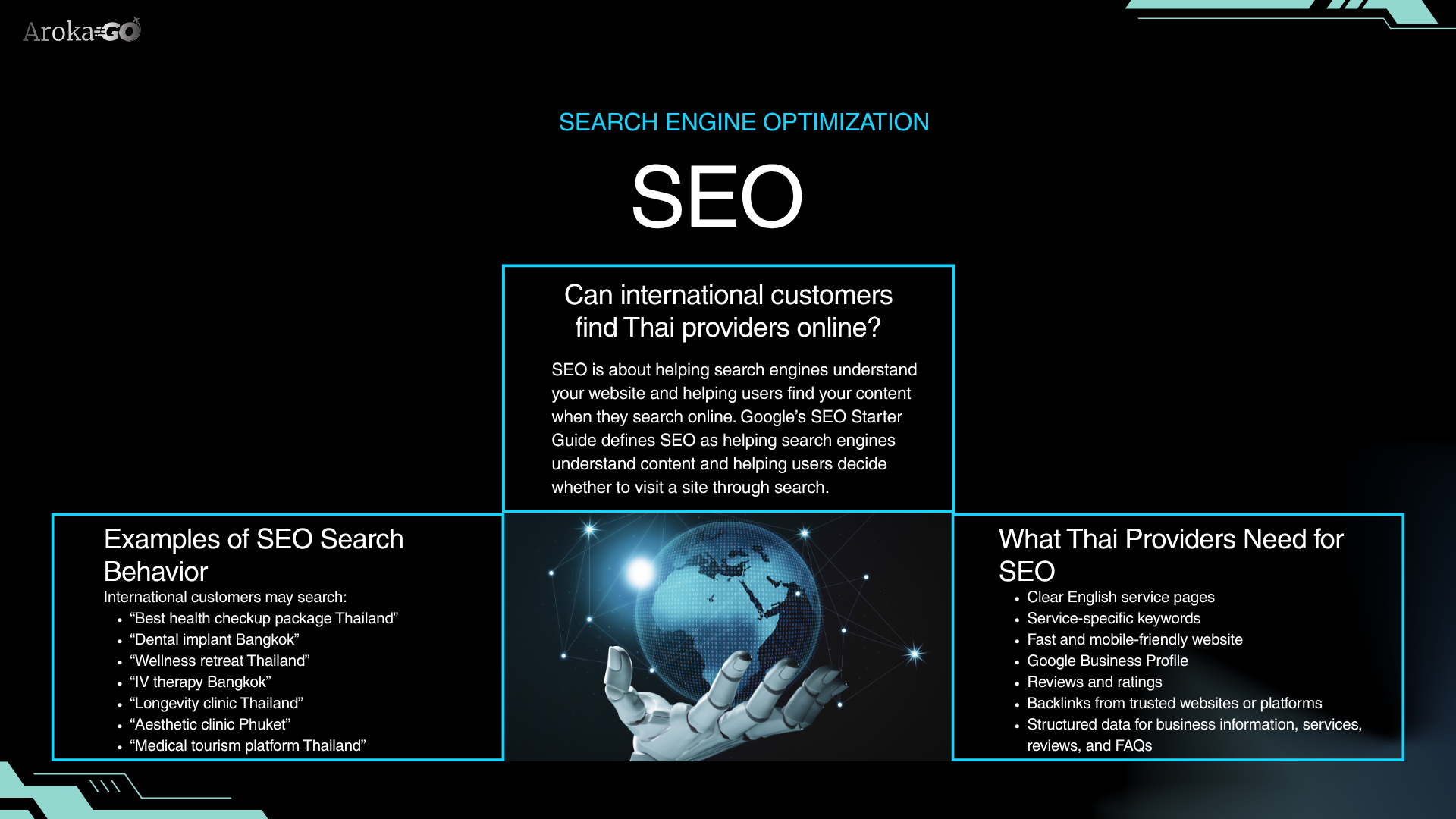
SEO, or Search Engine Optimization, is the process of improving a website or digital content so that it can be discovered through search engines such as Google.
For healthcare and wellness providers, SEO answers one simple business question:
“Are we searchable?”
If an international customer searches for services in Thailand, can they find your hospital, clinic, wellness center, spa, or provider profile?
Examples of SEO Search Behavior
Potential customers may search for:
- Best health checkup package in Thailand
- Dental implant clinic in Bangkok
- Wellness retreat in Phuket
- Longevity clinic Thailand
- IV therapy Bangkok
- Aesthetic clinic Thailand
- Fertility clinic Bangkok
- Rehabilitation center Thailand
- Thai medical tourism platform
These are traditional keyword-based searches. They are still important because search engines remain a major gateway for customers who are exploring treatment or wellness options abroad.
What Providers Need for SEO
A strong SEO foundation should include:
- Clear English service pages
- Relevant keywords for each service
- Mobile-friendly website design
- Fast page loading speed
- Location-based content
- Google Business Profile
- Reviews and ratings
- Quality backlinks from trusted websites
- Structured data where appropriate
- Clear contact and inquiry channels
For example, a dental clinic should not rely on one general homepage. It should have dedicated pages for dental implants, veneers, crowns, checkups, and international patient services. A wellness resort should have separate content for stress recovery, detox programs, sleep wellness, longevity programs, and executive wellness retreats.
SEO helps the provider become visible when the customer starts searching.
3. AEO: Answer Engine Optimization
What is AEO?
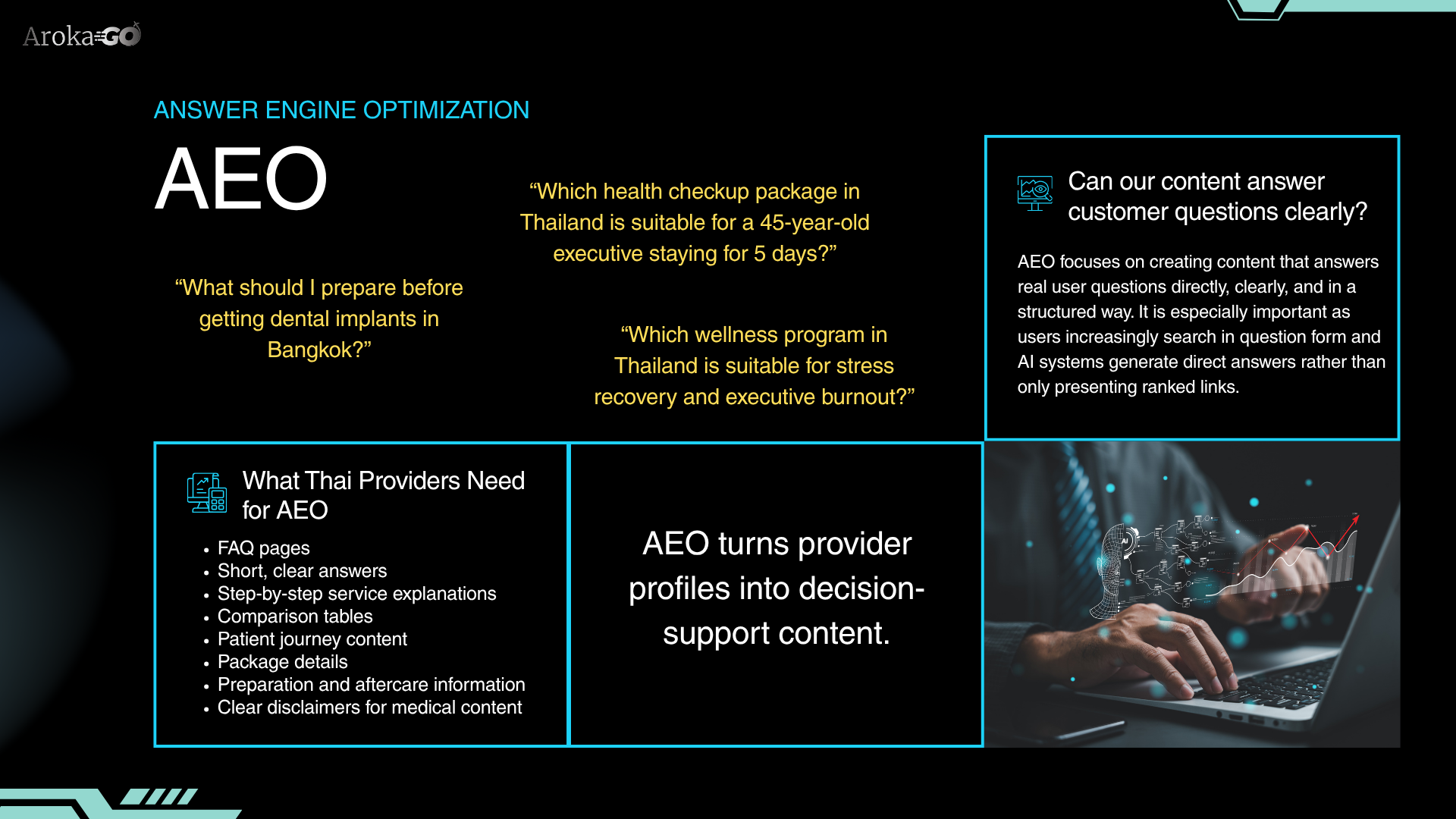
AEO, or Answer Engine Optimization, focuses on creating content that directly answers customer questions.
While SEO is about being found, AEO is about being useful once the customer arrives.
AEO answers the question:
“Are we answerable?”
Can your content clearly answer the real questions customers have before they contact you?
From Keywords to Questions
Customer behavior is changing from short keyword searches to question-based searches.
Instead of searching only:
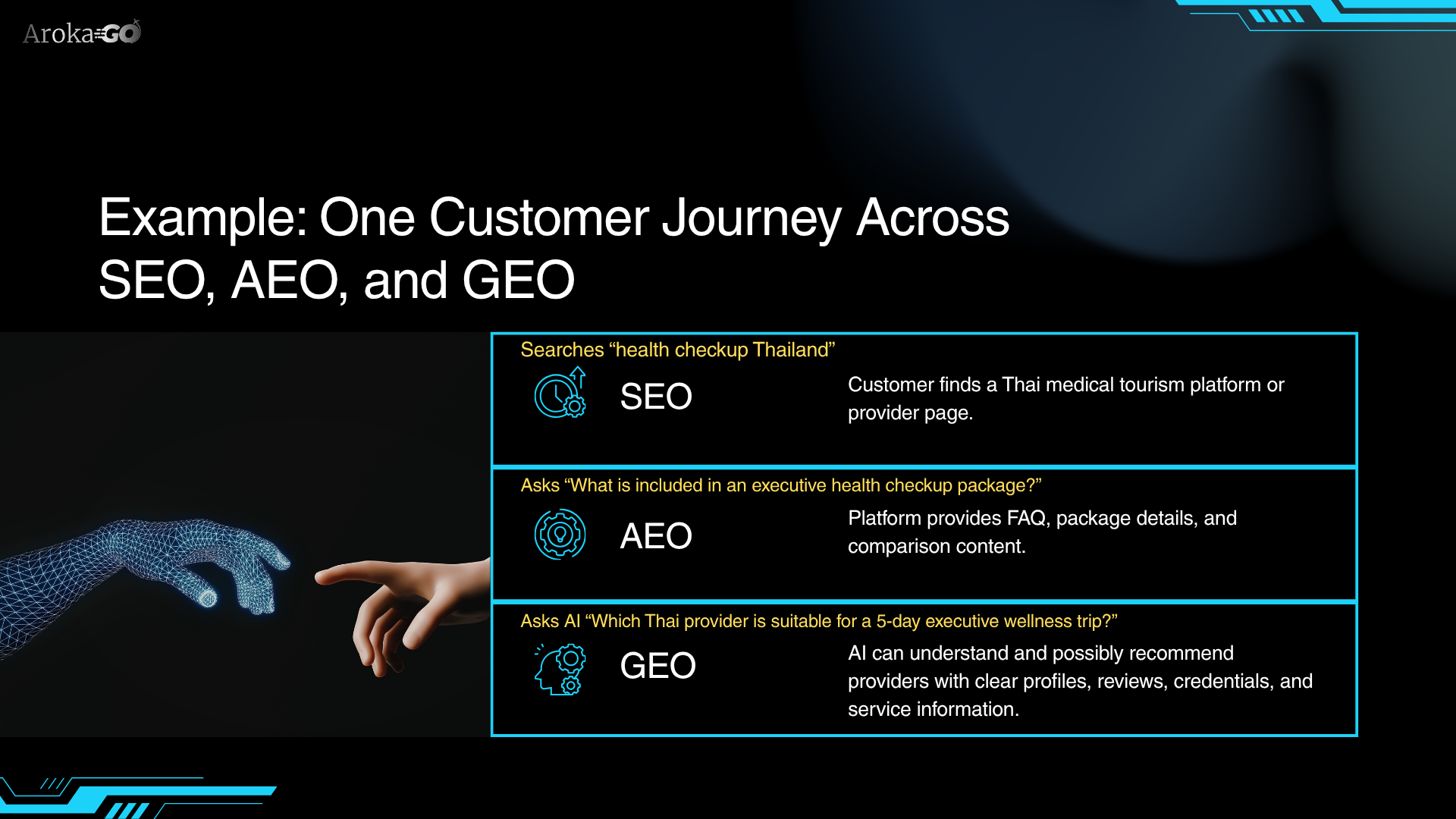
“Health checkup Thailand”
A customer may ask:
“Which health checkup package in Thailand is suitable for a 45-year-old executive staying for 5 days?”
Instead of searching:
“Dental implant Bangkok”
A customer may ask:
“What should international patients prepare before getting dental implants in Bangkok?”
Instead of searching:
“Wellness retreat Thailand”
A customer may ask:
“Which wellness program in Thailand is suitable for stress recovery and executive burnout?”
These are not simple keywords. They are decision-making questions.
What Providers Need for AEO
To support AEO, providers should create content that answers questions clearly and responsibly. This may include:
- Frequently Asked Questions
- Step-by-step service explanations
- Treatment or program timelines
- Preparation guidelines
- Aftercare information
- Package inclusions
- Suitability information
- Safety considerations
- International patient support information
- Clear explanations of what is included and not included
- Medical disclaimers where appropriate
For example, an executive health checkup page should answer questions such as:
- Who is this package suitable for?
- How long does the checkup take?
- How many days should an international customer stay in Thailand?
- What tests are included?
- Is English-speaking support available?
- Can the customer combine health screening with wellness recovery?
- How does the booking process work?
AEO is especially important in healthcare because customers need clarity before they make decisions.
4. GEO: Generative Engine Optimization
What is GEO?
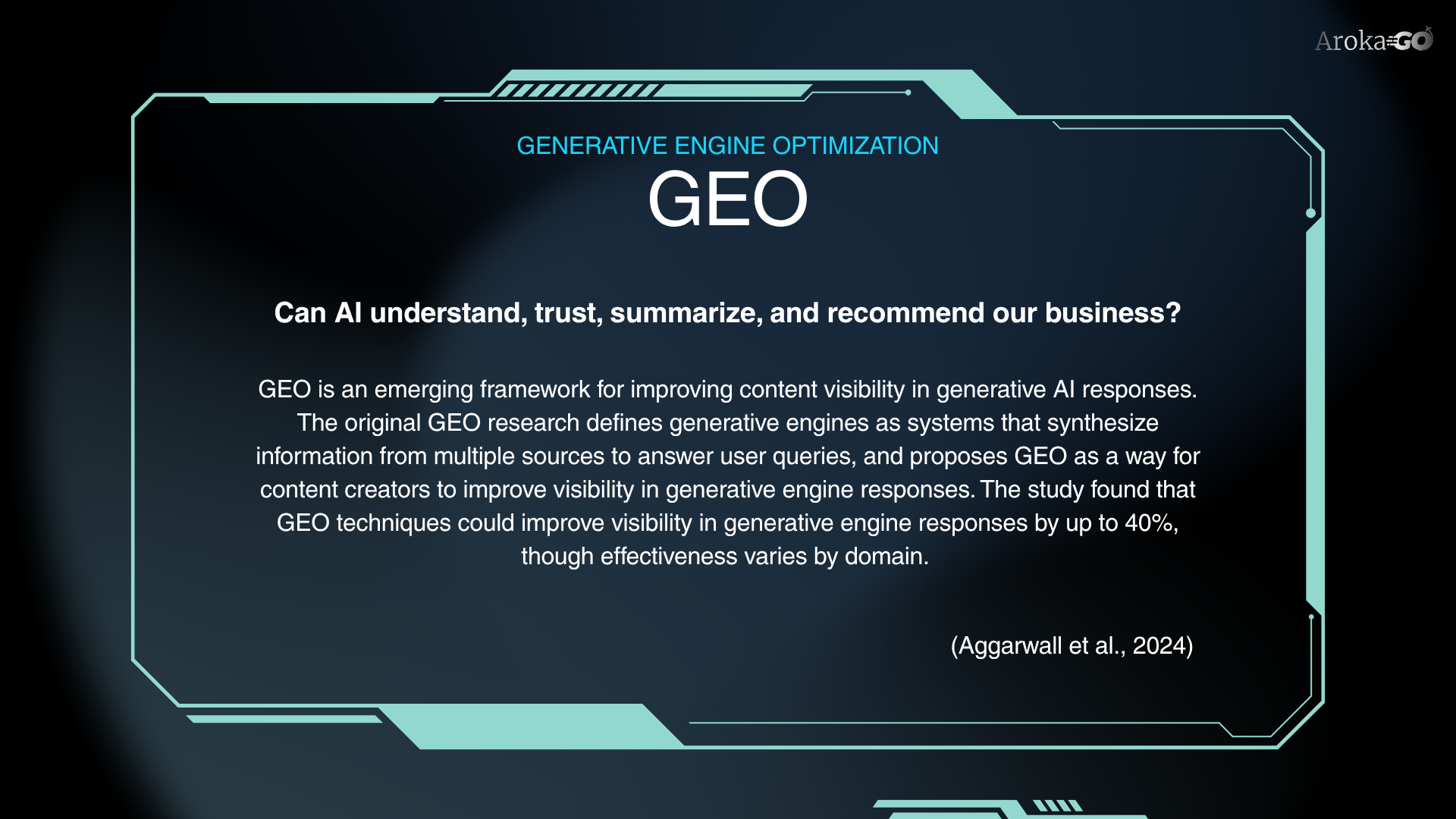
GEO, or Generative Engine Optimization, is an emerging approach to improving content visibility in generative AI systems, such as AI-powered search engines, AI answer engines, chatbots, and generative AI platforms.
GEO answers the question:
“Are we recommendable by AI?”
Can AI systems understand, trust, summarize, and potentially recommend your business?
This does not mean trying to manipulate AI. In healthcare, that would be risky and unethical. Instead, GEO should focus on making provider information accurate, structured, transparent, evidence-based, and easy to interpret.
Why GEO Matters
Generative AI tools do not only show a list of links. They often synthesize information from multiple sources and produce a direct answer. This means a customer may ask AI:
“I am planning a 5-day medical wellness trip to Thailand. I want a premium health checkup and wellness recovery program. What type of provider should I consider?”
Or: “How can I compare trusted dental implant providers in Thailand?”
Or: “Which Thai wellness providers are suitable for stress recovery and executive burnout?”
In these cases, AI may summarize general advice, compare provider types, and may cite or mention sources it considers relevant and trustworthy.
For providers, the implication is clear: if your information is not structured, credible, complete, and visible across trusted sources, AI may not understand or recommend your business.
What Providers Need for GEO
GEO-ready provider information should include:
- Accurate provider name
- Clear location
- Main specialties
- Service categories
- Doctor, therapist, or specialist profiles
- Professional credentials
- Licenses, certifications, and standards
- Clear service descriptions
- Package details
- Languages supported
- International patient support
- Reviews and testimonials
- Frequently asked questions
- Transparent safety information
- Third-party mentions or media coverage
- Consistent information across platforms
For medical and wellness tourism, GEO is closely connected to trust. AI systems are more likely to interpret a provider as credible when information is clear, consistent, and supported by meaningful signals of expertise and reliability.
5. SEO vs AEO vs GEO: How They Work Together
SEO, AEO, and GEO should not be treated as separate strategies. They work together across the customer journey.
|
Framework |
Main Question |
Customer Behavior |
Provider Goal |
|
SEO |
Are we searchable? |
Customers search keywords |
Help customers find the provider |
|
AEO |
Are we answerable? |
Customers ask questions |
Help customers understand the service |
|
GEO |
Are we recommendable by AI? |
Customers ask AI for guidance |
Help AI understand, trust, and recommend the provider |
A strong medical tourism platform should support all three layers.
SEO brings customers to the provider.
AEO answers customer questions.
GEO increases the chance that the provider is understood and recommended in AI-assisted discovery.
The new digital goal is no longer only to rank. The goal is to be found, understood, trusted, and recommended.
6. The New Customer Journey in the AI Era
The international health traveler’s journey is becoming more digital and more complex.
A typical journey may look like this:
- The customer becomes aware of a health or wellness need.
- The customer searches on Google.
- The customer asks AI for advice.
- The customer compares providers.
- The customer reads reviews and checks credentials.
- The customer visits a platform or provider page.
- The customer sends an inquiry.
- The customer evaluates response speed and professionalism.
- The customer makes a booking decision.
- The customer receives service and later leaves a review.
At every stage, digital content plays a role.
For Thai providers, this means provider profiles must function as digital trust assets. They should not only describe services but also help customers make informed decisions.
7. Why This Matters for Thai Medical and Wellness Providers
Thailand has strong advantages in medical and wellness tourism, including quality healthcare services, experienced professionals, hospitality, wellness traditions, competitive pricing, and a strong tourism ecosystem.
However, global competition is increasing. Other destinations are also promoting medical tourism, wellness tourism, longevity programs, aesthetic services, dental care, and recovery experiences.
Thai providers must therefore compete not only through service quality but also through digital clarity and international visibility.
A provider may have excellent doctors, beautiful facilities, strong patient care, and advanced technology. But if international customers cannot find that provider online, cannot understand the service clearly, or cannot see enough trust signals, the provider may lose opportunities to competitors with stronger digital communication.
Digital visibility is now part of national competitiveness in medical and wellness tourism.
8. ArokaGO’s Role: Making Thai Providers More Searchable, Answerable, and AI-Ready
ArokaGO supports Thailand’s medical and wellness tourism ecosystem by helping international customers discover trusted healthcare and wellness providers.
As a platform, ArokaGO helps improve provider visibility by presenting information in a more structured, searchable, and customer-friendly format.
A strong provider profile on a medical tourism platform should help customers answer key questions:
- What services does the provider offer?
- Where is the provider located?
- Who are the doctors or experts?
- What makes the provider trustworthy?
- What languages are supported?
- What type of international customer is the service suitable for?
- What should the customer prepare before booking?
- How can the customer contact the provider?
- Are there reviews or verified information?
In the AI era, this structure is also important because AI systems need clear and consistent information to interpret provider credibility and relevance.
ArokaGO’s platform approach is aligned with the future of search: helping providers become more visible, more understandable, and more trusted by both people and intelligent systems.
9. Practical SEO, AEO, and GEO Checklist for Providers
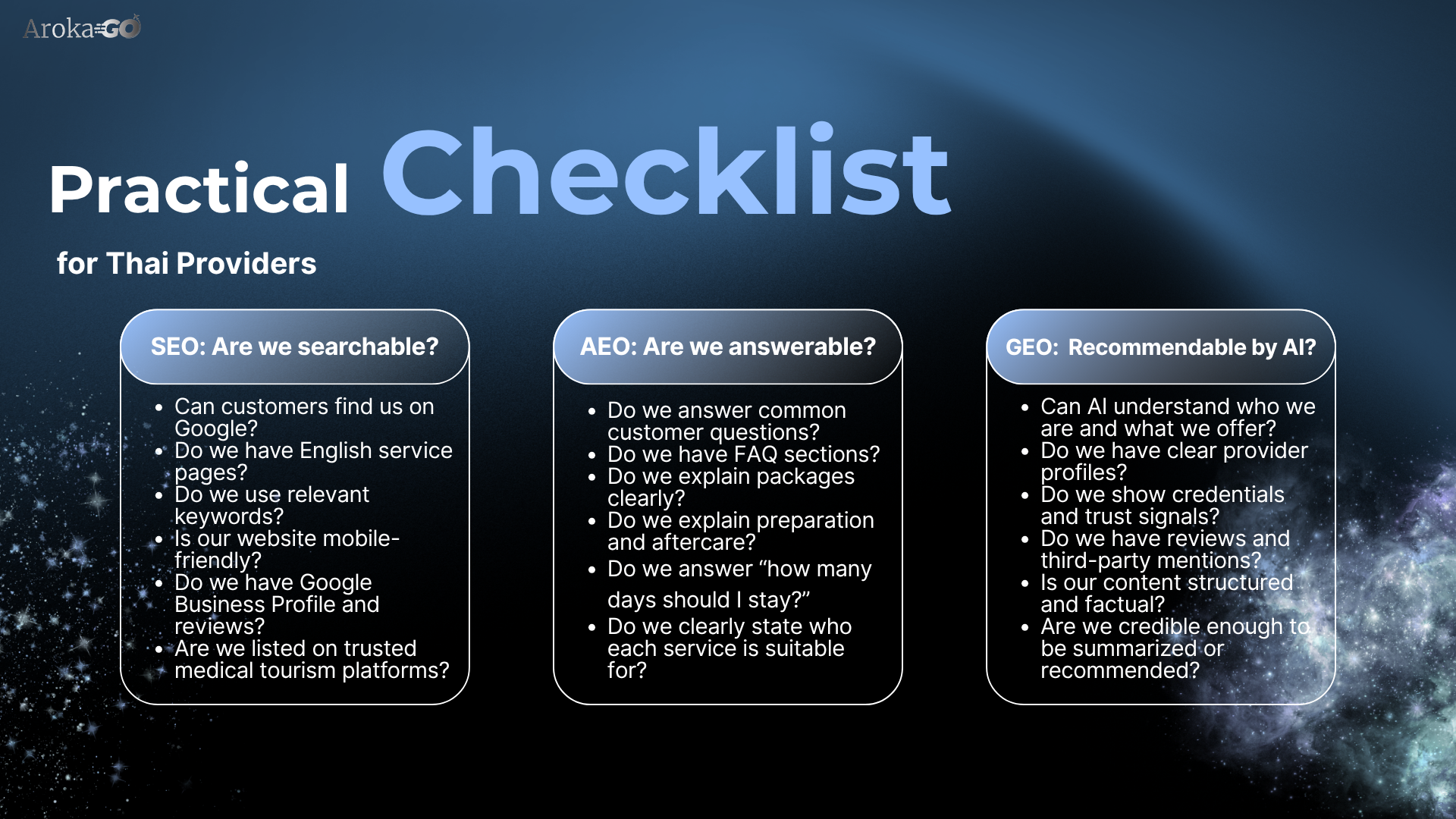
SEO Checklist: Are You Searchable?
- Does your website have English content?
- Do you have dedicated pages for each service?
- Are your pages optimized for relevant keywords?
- Is your website mobile-friendly?
- Is your Google Business Profile updated?
- Do you have high-quality photos?
- Do you have reviews?
- Are your contact details easy to find?
- Are you listed on trusted platforms or directories?
AEO Checklist: Are You Answerable?
- Do you have FAQ sections?
- Do you clearly explain your services?
- Do you explain who each service is suitable for?
- Do you explain preparation and aftercare?
- Do you provide package details?
- Do you answer “how many days should I stay?”
- Do you provide clear inquiry steps?
- Do you offer English-language support?
- Do you use simple and patient-friendly language?
GEO Checklist: Are You Recommendable by AI?
- Can AI understand who you are and what you offer?
- Do you show professional credentials?
- Do you display licenses, standards, or accreditations?
- Do you have credible reviews and testimonials?
- Do you have third-party mentions or media coverage?
- Is your information consistent across websites, platforms, and social media?
- Do you avoid exaggerated medical claims?
- Is your content structured with headings, bullets, tables, and FAQs?
- Is your content trustworthy enough for health-related decision-making?
10. Ethical Considerations for Healthcare Content
Medical and wellness tourism content must be handled carefully. Unlike general consumer content, healthcare information can influence personal health decisions. This means providers should avoid exaggerated claims, unsupported promises, or misleading before-and-after narratives.
Responsible healthcare content should be:
- Accurate
- Transparent
- Evidence-informed
- Reviewed by qualified professionals where necessary
- Clear about limitations
- Respectful of patient privacy
- Compliant with relevant laws and professional standards
- Presented with appropriate disclaimers
AI can help providers create content, translate information, summarize services, and prepare customer responses. However, AI should support human expertise, not replace medical judgment.
In healthcare, trust is not created by technology alone. Trust comes from professional standards, ethical communication, verified expertise, and responsible service delivery.
11. The Future: From Ranking to Recommendation
The future of digital marketing in medical and wellness tourism will not be only about ranking on Google. It will be about becoming a trusted digital source that customers and AI systems can understand.
The next generation of health travelers will expect:
- Clear online information
- Transparent service details
- Easy inquiry and booking
- Multilingual communication
- Verified provider profiles
- Trustworthy reviews
- Fast response
- Personalized recommendations
- AI-assisted comparison
- Seamless digital-to-service experience
Providers that invest in SEO, AEO, and GEO will be better positioned to compete internationally.
They will not only be easier to find. They will be easier to understand, easier to trust, and easier to recommend.
Conclusion
SEO, AEO, and GEO represent the new digital visibility framework for medical and wellness tourism.
SEO helps customers find Thai providers.
AEO helps customers understand services and make informed decisions.
GEO helps AI systems interpret, trust, and potentially recommend providers.
For Thailand, this is more than a marketing issue. It is a strategic opportunity to strengthen the country’s position as a global medical and wellness tourism destination.
ArokaGO is committed to supporting Thai healthcare and wellness providers by improving digital visibility, strengthening international communication, and helping providers become more searchable, answerable, and AI-ready.
In the new era of medical and wellness tourism, the winners will not only be the providers with excellent services. They will be the providers that customers can find, understand, trust, and choose.
References
Aggarwal, P., Murahari, V., Rajpurohit, T., Kalyan, A., Narasimhan, K., & Deshpande, A. (2023). GEO: Generative Engine Optimization. arXiv.
DataReportal. (2026). Digital 2026: Global Overview Report.
DataReportal. (2026). Digital 2026: Thailand.
Hong, Y. A., Liang, C., Radcliff, T. A., Wigfall, L. T., & Street, R. L. (2019). What Do Patients Say About Doctors Online? A Systematic Review of Studies on Patient Online Reviews. Journal of Medical Internet Research.
Kaiser Family Foundation. (2026). KFF Tracking Poll on Health Information and Trust: Use of AI for Health Information and Advice.
OECD. (2025). Health at a Glance 2025: Data and Digital.
World Health Organization. (2021). Ethics and Governance of Artificial Intelligence for Health.
World Health Organization. (2024). Ethics and Governance of Artificial Intelligence for Health: Guidance on Large Multi-Modal Models.
Xu, H., Iqbal, U., & Montgomery, J. M. (2026). Measuring Google AI Overviews: Activation, Source Quality, Claim Fidelity, and Publisher Impact. arXiv.
ArokaGO
Share this article
More Articles
Discover more insights on health care and medical tourism.

Waking Up Tired? It Could Be a Sign of Adrenal Fatigue
Every morning, your adrenal glands quietly get to work producing the hormones that help you feel refreshed and ready to take on the day, whether that's a busy schedule at the office or simply the energy to enjoy your morning routine. So when a bright, easy start to the day starts to feel harder to come by, and even things you usually enjoy feel like an effort, it's worth paying attention. This shift is often the body's way of asking for support a sign sometimes referred to as adrenal fatigue.

What are the Common Causes of Infertility?
Many people grow up looking forward to the day they can have children. However, many people find that they’re unable to have children no matter how hard they try. If you are having difficulty getting pregnant, the good news is that treatment is often available, meaning you can still have the family of your dreams. However, before you can treat infertility, you first need to know what is causing it, and there are several potential causes. There are numerous potential causes of infertility, and each can be treated in different ways, if at all. Below are some of the most common causes of all.

Thigh Liposuction
Thigh Liposuction, wave goodbye to big legs with the Liposuction method Have you ever dedicated yourself to heavy exercise, yet the fat around your thighs never seems to decrease? It is believed that many people who clicked to read this article are likely among those facing such issues, feeling more or less anxious about their body shape.