
Siriraj - Mahidol Advances Personalized Skin Regeneration with SiRiGevity Autologous Fibroblast Technology
Siriraj Hospital and Mahidol University move to translate research into practical applications through SiRiGevity, bringing together medical researchers, dermatologists, and industry partners to advance personalized skin regeneration and skin longevity.
Siriraj Hospital and Mahidol University move to translate research into practical applications through SiRiGevity, bringing together medical researchers, dermatologists, and industry partners to advance personalized skin regeneration and skin longevity.
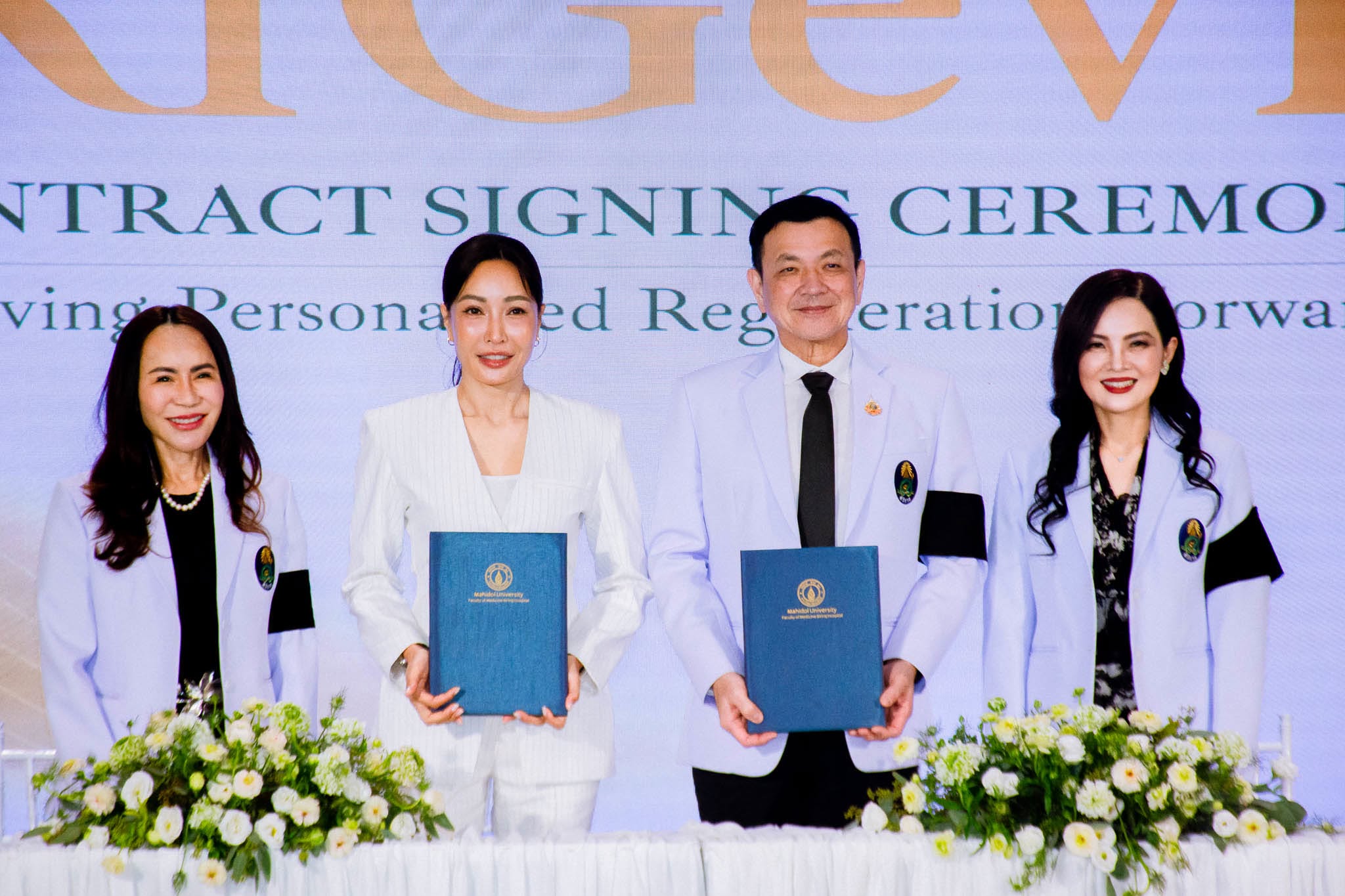
The Faculty of Medicine Siriraj Hospital, Mahidol University, organized a press conference and contract signing ceremony to appoint service providers under the SiRiGevity brand for autologous fibroblast cell services.
Held under the theme “SiRiGevity Contract Signing Ceremony - Moving Personalized Regeneration Forward,” the event highlighted the development of second-generation autologous fibroblast technology (Autologous Fibroblast Gen II) under the concept “Your Cells. Your Skin.”
The initiative brings together researchers, medical specialists, and industry partners to translate scientific research into practical applications and advance the future of personalized skin care.

The event took place at 10:00 a.m. in the Sirindhorn Conference Room, Ground Floor, Chalermprakiat Building, Siriraj Hospital, with distinguished participants including:
-
Professor Dr. Keerati Chareancholvanich, Dean of the Faculty of Medicine Siriraj Hospital, Mahidol University.
-
Professor Dr. Prasert Auewarakul, Deputy Dean for Research, Faculty of Medicine Siriraj Hospital, Mahidol University.
-
Professor Dr. Uraiwan Panich, Deputy Dean for Innovation, Faculty of Medicine Siriraj Hospital, Mahidol University.
-
Professor Dr. Rungsima Wanitphakdeedecha, Head of the Department of Dermatology, Faculty of Medicine Siriraj Hospital, Mahidol University.
-
Professor Dr. Wiriya Techaarpornkul, Director of the Institute for Technology and Innovation Management (iNT), Mahidol University.
-
Associate Professor Dr. Pattana Teng-umnuay, Advisor to the Dean for Anti-Aging and Regenerative Medicine at the College of Integrative Medicine, Dhurakij Pundit University, and Executive Chairman of CELTAC Co., Ltd.
-
Dr. Chutima Asaneerakorn, Executive Chairperson and Founder of Edencolors (Thailand) Co., Ltd.
Siriraj Drives Real World Impact Through Research and Innovation
The collaboration aligns with Mahidol University's commitment to translating academic research into tangible benefits for society under its Real World Impact vision.
The Faculty of Medicine Siriraj Hospital prioritizes research that originates from medical challenges, is supported by scientific evidence, and has the potential to be developed into innovations suitable for practical applications and responsible commercialization.
Professor Dr. Keerati Chareancholvanich explained that Mahidol University places significant emphasis on advancing research and innovation that deliver meaningful benefits to society.
In response to this vision, the Faculty of Medicine Siriraj Hospital supports research that addresses medical needs through evidence-based knowledge development, with the potential to translate scientific discoveries into practical and commercial applications responsibly.
These efforts are guided by scientific evidence, professional standards, and patient safety.
The collaboration under the SiRiGevity brand represents an example of how academic research can be connected with real-world applications to create value and respond to the evolving needs of healthcare systems and the public.
Preclinical - Clinical Collaboration: Connecting Laboratory Research with Clinical Needs
SiRiGevity was developed through collaboration between basic science researchers and dermatology specialists, integrating cellular biology with clinical needs as the foundation for technological development.
This approach, known as Preclinical–Clinical Collaboration, incorporates systematic testing and evaluation throughout the research and development process.
Professor Dr. Uraiwan Panich, Deputy Dean for Innovation, outlined the importance of this interdisciplinary collaboration and the scope of the preclinical research.
The studies include in vitro investigations examining the role of fibroblasts in intercellular communication and biological markers associated with collagen changes and ultraviolet radiation-induced skin damage.
Importantly, findings from cellular-level experiments provide mechanistic scientific evidence and cannot substitute for clinical evidence demonstrating treatment outcomes in humans.
From Clinical Needs to SiRiGevity: Exploring Skin Regeneration Using Patients' Own Cells
Fibroblasts are essential cells located within the dermis, the deeper layer of the skin. They play an important role in producing collagen, elastin, and components of the extracellular matrix (ECM), which contribute to skin strength, elasticity, and structural integrity.
As individuals age or their skin is exposed to factors that accelerate deterioration, fibroblast activity and the structural characteristics of the skin may change.
The concept behind SiRiGevity involves collecting fibroblasts from an individual's own body, known as autologous fibroblasts, and expanding these cells in a laboratory under controlled quality assurance processes.
The cultured cells may subsequently be used in accordance with appropriate medical indications and clinical guidelines.
This approach differs mechanistically from conventional dermal fillers, which primarily aim to restore or increase tissue volume. Autologous fibroblast technology instead explores the potential of biological processes and tissue regeneration in personalized skin care.
Professor Dr. Rungsima Wanitphakdeedecha, Head of the Department of Dermatology and one of the technology's inventors, highlighted the clinical needs that contributed to its development.
These include the importance of exploring alternative approaches that consider both effectiveness and safety, particularly concerns regarding vascular complications associated with certain injectable filler procedures.
However, the use of autologous fibroblasts does not mean that the procedure is risk-free, nor has it been established that this approach can prevent all vascular complications.
The research team has conducted clinical studies investigating the application of cultured autologous fibroblasts, with follow-up assessments and evaluations of skin changes at predetermined intervals.
These studies aim to examine the potential benefits, limitations, and safety of the technology.
The research is guided by the concepts of Regeneration and Skin Longevity, which emphasize understanding and supporting long-term skin health.
Advancing from Gen 1 to Gen 2 Through Intellectual Property and Technology Licensing
The research team has continuously developed its fibroblast cell culture technology.
The first-generation technology (Gen 1) received a petty patent in 2023 and was licensed to a private-sector partner in the same year.
The second-generation technology (Gen 2) builds upon this foundation through further development of the cell culture process.
A patent application has already been filed for a method of culturing autologous fibroblasts using prepared and conditioned cell culture media.
Professor Dr. Wiriya Techaarpornkul, Director of Mahidol University's Institute for Technology and Innovation Management (iNT), highlighted the importance of protecting researchers' intellectual property and the role of Technology Licensing in connecting academic research with industry partners.
This process supports the appropriate and responsible commercialization of university-developed technologies while facilitating their translation into practical applications.
CELTAC and Edencolors Collaborate on Cell Culture and Service Network Development
The SiRiGevity initiative also involves collaboration with private-sector partners to support cell culture operations and the development of a service network.
Associate Professor Dr. Pattana Teng-umnuay, Advisor to the Dean for Anti-Aging and Regenerative Medicine at the College of Integrative Medicine, Dhurakij Pundit University, and Executive Chairman of CELTAC Co., Ltd., shared the company's experience in obtaining a license for the first-generation fibroblast technology approximately three years ago, as well as its ongoing collaboration in cell culture development.
According to CELTAC, the company currently operates a Class 100 cleanroom facility and plans to further develop its laboratory infrastructure, operational systems, and quality management processes in alignment with Good Manufacturing Practice (GMP) standards in the future.
Meanwhile, Dr. Chutima Asaneerakorn, Executive Chairperson and Founder of Edencolors (Thailand) Co., Ltd., outlined the company's approach to developing the SiRiGevity brand and its service network.
The initiative aims to improve access to the technology while prioritizing accurate scientific information, operational standards, and compliance with applicable legal requirements.
The appointment of service providers under the SiRiGevity brand is intended to support the systematic translation of the technology into practical applications.
Prioritizing Quality Control, Safety, and Regulatory Compliance
The cultivation of autologous cells from individual patients requires careful attention to multiple aspects of laboratory operations and quality management.
These include:
-
Quality control throughout the cell culture process.
-
Prevention of contamination.
-
Traceability of biological samples and cell products.
-
Compliance with applicable professional standards.
-
Adherence to relevant laws and regulatory requirements.
These considerations are essential to ensuring that service development prioritizes patient safety and long-term reliability.
The collaboration between Siriraj Hospital, Mahidol University, and industry partners represents an effort to advance personalized regenerative medicine by connecting scientific research, clinical expertise, intellectual property management, and responsible commercialization.
Through SiRiGevity, the initiative aims to contribute to the continued development of personalized skin care and skin longevity technologies grounded in scientific evidence and appropriate medical standards.
Further Information
For research-related inquiries:
Corporate Communications Division, Faculty of Medicine Siriraj Hospital, Mahidol University
Tel: +66 2 419 8992
For information regarding innovations and services under the SiRiGevity brand:
Edencolors (Thailand) Co., Ltd.
Tel: +66 2 125 0142, +66 93 195 5965, +66 61 553 6615
LINE Official Account: @edencolors
Source: Faculty of Medicine Siriraj Hospital, Mahidol University, November 24, 2026.
Articles in this category are written by our editorial team to keep you informed about the latest healthcare and medical tourism news.
