
Thailand Ranks 38th in WEF Travel & Tourism Development Index 2026 as Asia-Pacific Tourism Gains Momentum
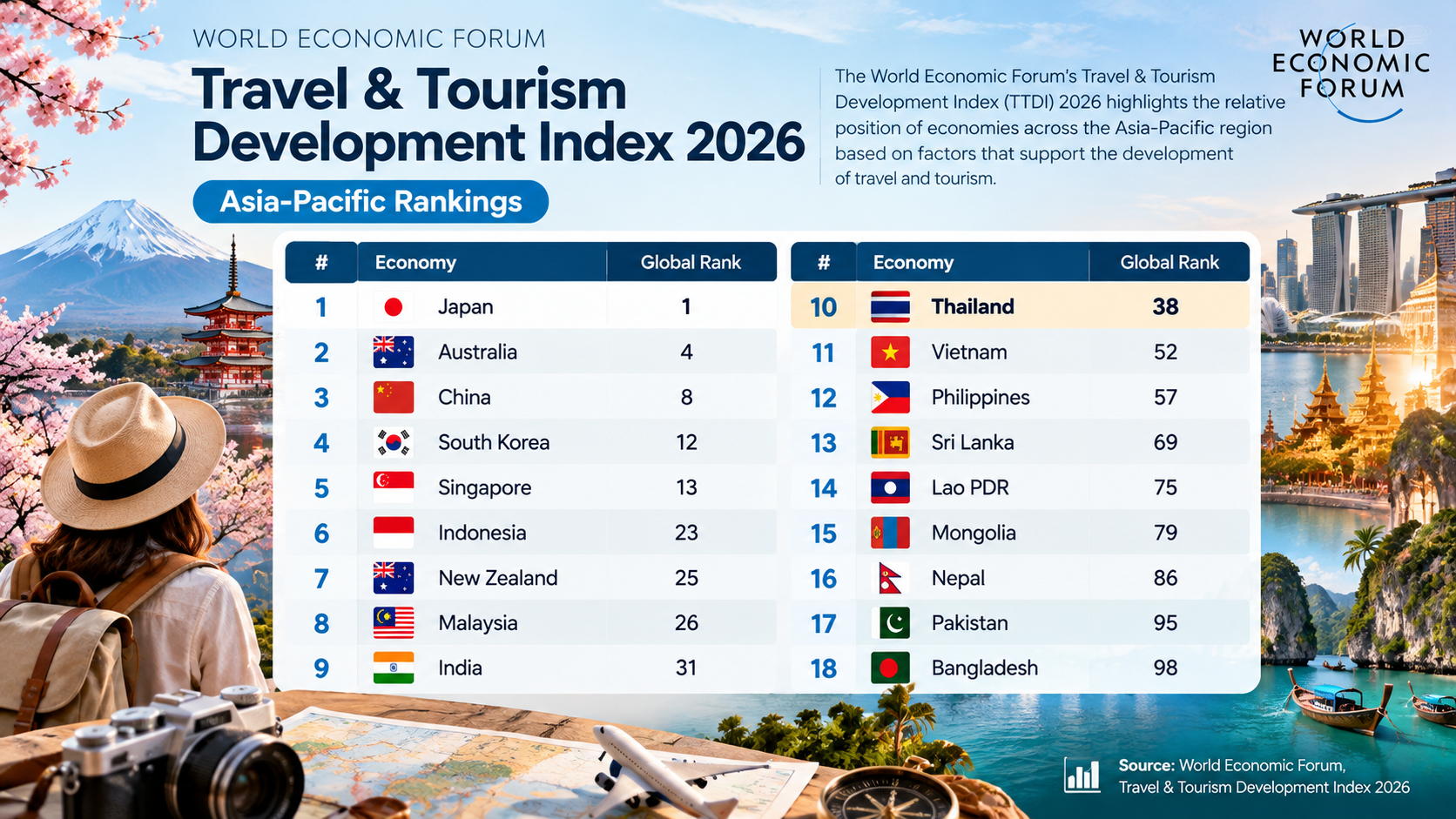
Thailand has been placed 38th globally in the World Economic Forum's Travel & Tourism Development Index (TTDI) 2026, according to a regional ranking summary. The latest WEF report also highlights Thailand as one of Asia-Pacific's improving tourism economies, with its index score rising 5.6% between 2024 and 2026.
Thailand has been placed 38th globally in the World Economic Forum's Travel & Tourism Development Index (TTDI) 2026, according to a regional ranking summary. The latest WEF report also highlights Thailand as one of Asia-Pacific's improving tourism economies, with its index score rising 5.6% between 2024 and 2026.
The World Economic Forum (WEF) released its Travel & Tourism Development Index 2026 on September 25, assessing 110 economies based on the conditions that support sustainable and resilient tourism development.
Japan secured first place globally, followed by the United States and Spain, while Australia ranked fourth and China eighth.
The report found that 101 of the 110 assessed economies improved their index scores compared with 2024, reflecting stronger tourism infrastructure, connectivity and supporting services across much of the world.
Asia-Pacific recorded the strongest regional improvement, with its average score increasing by 3.6%.
Thailand's Tourism Development Shows Positive Progress
Thailand's reported global position of 38th places it among the Asia-Pacific economies featured in the ranking summary.
More significantly, the WEF's official analysis identifies Thailand as one of the developing tourism economies demonstrating notable improvement.
Between 2024 and 2026, Thailand's TTDI score increased by 5.6%, compared with an average improvement of approximately 2.1% across all ranked economies.
The report also identifies Lao PDR and Malaysia among the region's improving economies, with score increases of 6.1% and 5.8%, respectively.
These developments reflect growing momentum among emerging tourism destinations in Southeast Asia.
Asia-Pacific Travel & Tourism Rankings 2026
The following positions are based on the Asia-Pacific ranking summary provided for this article. The global top positions have been cross-checked against the WEF report, while the remaining individual placements should be checked against the downloadable WEF dataset before publication.
What Does the Travel & Tourism Development Index Measure?
The TTDI evaluates the conditions and policies that enable tourism economies to develop sustainably.
Its assessment includes factors such as transport infrastructure, tourism services, digital readiness, health and hygiene, safety, natural and cultural resources, and environmental sustainability.
Unlike rankings based on international visitor arrivals or tourism revenue, the TTDI examines the broader systems that support long-term tourism development.
A higher position therefore reflects stronger overall enabling conditions rather than necessarily indicating a larger number of tourists.
Opportunities for Thailand's Medical and Wellness Tourism Industry
Thailand's tourism development progress also provides an important context for the country's medical and wellness tourism sector.
International patients and wellness travelers depend on more than healthcare services alone. Convenient international connections, reliable transportation, suitable accommodation, digital information and coordinated visitor services can all influence their travel experience.
Thailand has an established medical tourism industry alongside wellness destinations, hospitality services and internationally oriented healthcare providers.
As the country continues strengthening tourism infrastructure and connectivity, there are opportunities to better integrate healthcare services with travel planning, accommodation and recovery-related support.
For medical and wellness tourism stakeholders, digital platforms, transparent provider information and accessible communication channels may help international visitors make more informed decisions.
However, the TTDI does not directly rank the quality of medical treatment, hospitals or medical tourism services. Thailand's overall tourism position should therefore not be interpreted as a healthcare-specific ranking.
Tourism Growth Must Be Supported by Sustainable Development
The WEF report highlights that tourism development conditions have improved substantially since the pandemic, but destinations continue to face challenges.
These include rising travel costs, infrastructure pressures, workforce shortages and environmental sustainability concerns.
For emerging tourism economies, the report identifies opportunities to strengthen visitor services, transportation networks and the systems needed to support long-term growth.
Thailand's continued progress will depend not only on attracting visitors but also on improving service quality, accessibility and sustainable tourism management.
Thailand's Position in Asia-Pacific Tourism
The TTDI 2026 illustrates the increasing importance of Asia-Pacific in global travel and tourism development.
Japan leads the global ranking, while several Southeast Asian economies have recorded meaningful improvements in their tourism development conditions.
For Thailand, the reported 38th-place ranking provides one perspective on its international position, while the officially documented 5.6% improvement offers evidence of progress in the underlying index.
As global tourism evolves, continued investment in connectivity, infrastructure, digital services and sustainable tourism could support Thailand's competitiveness, including its ambitions in medical and wellness tourism.
Source: World Economic Forum, Travel & Tourism Development Index 2026, published September 25, 2026.
Articles in this category are written by our editorial team to keep you informed about the latest healthcare and medical tourism news.
