The Royal College of Ophthalmologists of Thailand Issues Warning on One-Sided Information About Lens Replacement Surgery for Presbyopia
The Royal College of Ophthalmologists of Thailand has issued an official statement urging the public to exercise caution when consuming medical information shared on social media—particularly content that presents only the benefits of Refractive Lens Exchange (RLE) for correcting presbyopia (age-related farsightedness), without mentioning the potential risks and complications.
The Royal College of Ophthalmologists of Thailand has issued an official statement urging the public to exercise caution when consuming medical information shared on social media—particularly content that presents only the benefits of Refractive Lens Exchange (RLE) for correcting presbyopia (age-related farsightedness), without mentioning the potential risks and complications.
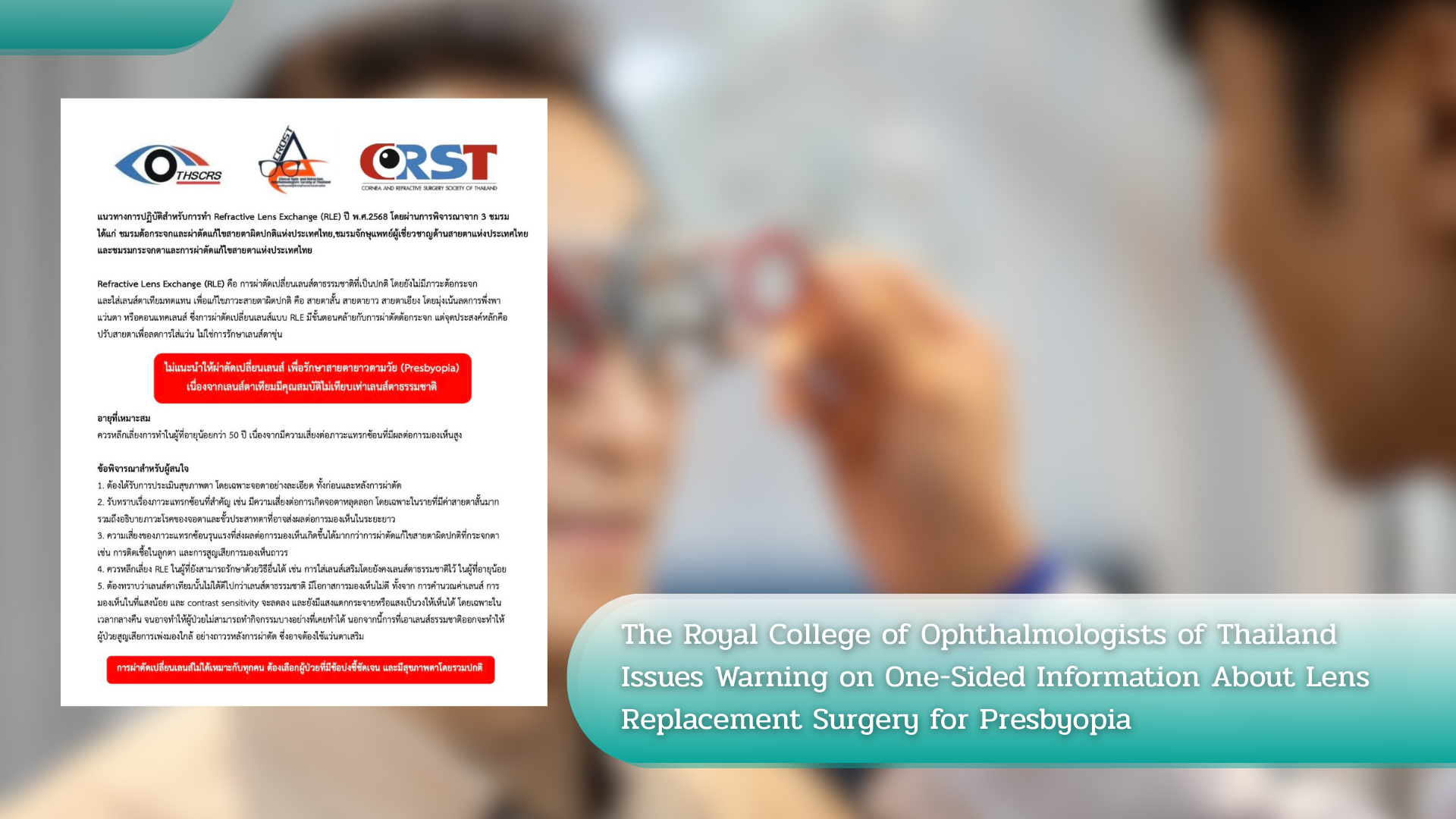
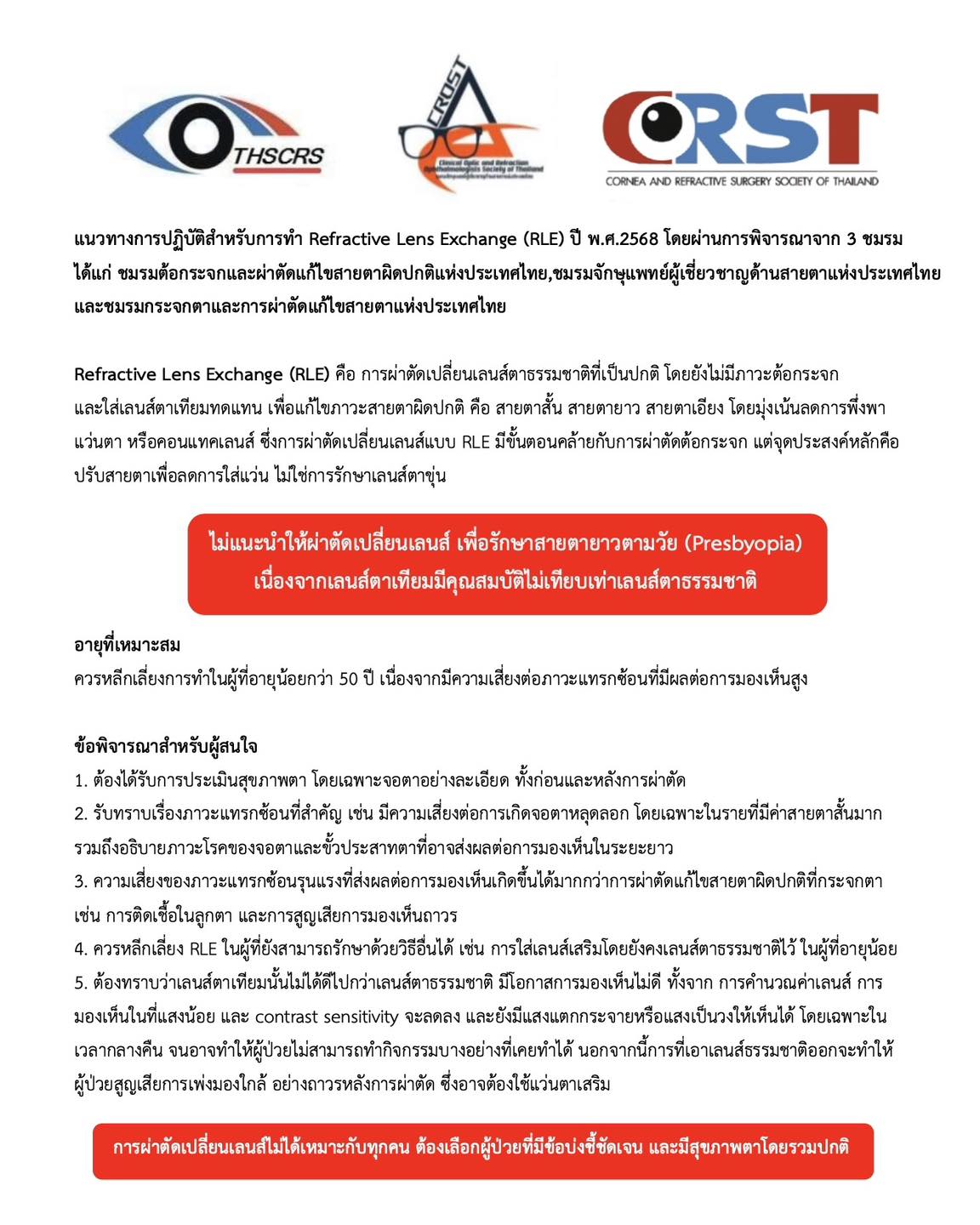
The College emphasized that RLE is not recommended as a treatment for presbyopia. This guidance is based on the 2025 clinical practice guidelines, jointly reviewed by three professional associations: the Cataract and Refractive Surgery Society of Thailand, the Thai Cornea and Refractive Surgery Society, and the Thai Society of Refractive Ophthalmologists.
What is Refractive Lens Exchange (RLE)?
RLE is a surgical procedure that involves removing a clear, natural lens of the eye (without cataract) and replacing it with an artificial intraocular lens (IOL) to correct refractive errors such as nearsightedness, farsightedness, or astigmatism. The goal is to reduce or eliminate dependence on glasses or contact lenses. While the procedure is similar to cataract surgery in technique, its primary purpose is vision correction, not the treatment of a cloudy lens.
Key Risks and Limitations of RLE
- Not suitable for individuals under 50 years old, due to higher risks of serious complications that may impair vision.
- Comprehensive eye evaluation is essential—particularly of the retina and optic nerve—both before and after the procedure.
- Patients must be informed of significant risks, such as retinal detachment (especially in those with high myopia), and the potential long-term impact on vision.
- Serious complications such as intraocular infection and permanent vision loss are more likely than with corneal refractive procedures.
- Artificial lenses do not outperform natural lenses. Patients may experience reduced vision in low-light conditions, lower contrast sensitivity, and visual disturbances like glare or halos—especially at night.
- Removal of the natural lens results in permanent loss of near focusing ability, which may require additional use of reading glasses post-surgery.
Consider Alternatives Before Proceeding
RLE should be avoided in patients who still have other treatment options, such as phakic intraocular lens implantation (implanting a lens while preserving the natural one), especially in younger individuals without cataract.
The Royal College reiterates that RLE is not appropriate for everyone. It should only be considered in patients with clearly defined medical indications and overall healthy eyes. Individuals considering the procedure are strongly encouraged to consult a certified ophthalmologist to ensure safety and suitability.
Source:
Facebook Page The Royal College of Ophthalmologists of Thailand
此类别中的文章由我们的编辑团队撰写,旨在让您了解最新的医疗保健和医疗旅游新闻。