free radical

Free radicals are unstable molecules that can be produced through chemical reactions in the human body. The body functions through countless chemical processes that occur continuously, even while we are asleep. It is estimated that billions of chemical reactions take place in the body every second as part of normal biological functions.
Some of these reactions can generate free radicals, meaning that free radicals are constantly being produced in the body. There are many types of free radicals, but the harmful ones can contribute to cellular damage, accelerate aging, and increase the risk of illness.
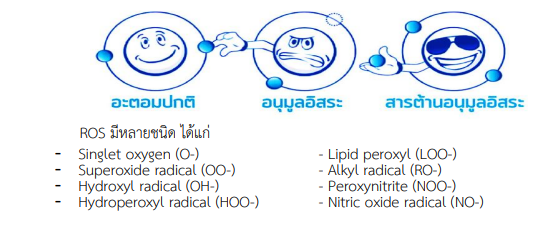
One of the most concerning types is free radicals that involve oxygen, known as reactive oxygen species, or ROS. When these molecules accumulate beyond the body’s ability to control them, they may lead to oxidative stress, which can affect overall health and the body’s natural aging process.
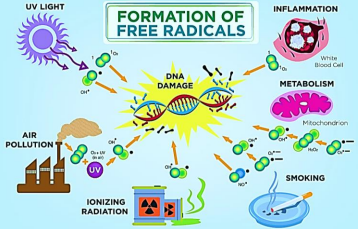
Where Do ROS Come From?
The sources of ROS can be divided into two main categories:
1.External Factors
External factors include:
- Fried, grilled, or barbecued foods, and alcoholic beverages
- Smoking
- Air pollution, environmental toxins, and various heavy metals such as mercury, lead, arsenic, aluminum, and cadmium
- Certain viral infections, such as hepatitis virus
- Certain medications and chemicals
- Radiation therapy for cancer treatment, as well as excessive exposure to sunlight
Free radicals from external factors account for only a small proportion compared with the amount of free radicals produced from internal factors within the body.
2.Internal Factors
Internal factors include:
- Chemical reactions from various bodily processes, especially the process of converting nutrients into energy, known as the energy cycle. This process requires oxygen as an important component and occurs continuously in every cell throughout the body. Once energy is produced, free radicals are also generated. This is the process that produces the greatest amount of free radicals.
- Various types of inflammation, such as
1.Chronic inflammation of bones, tendons, and joints caused by injury or degeneration of the body
2.Inflammation caused by the body’s attempt to eliminate foreign substances, such as heavy metals, various toxins, and pathogens
3.Chronic inflammation caused by inflammatory diseases. Most of these are autoimmune diseases, of which there are many types, such as SLE (Systemic Lupus Erythematosus), rheumatoid arthritis, chronic dermatitis, psoriasis, type 2 diabetes, thyroid inflammation or Hashimoto’s disease, Alzheimer’s disease, Parkinson’s disease, and others.
How Do Free Radicals Cause Damage?
Free radicals are particles that contain unpaired electrons. As a result, they need to take electrons from nearby molecules or neighboring cells in order to pair them and become stable. This creates a chain reaction known as oxidation. When there are high levels of free radicals, oxidation also increases. This condition is known as oxidative stress.
Oxidative stress can damage cellular components such as the cell membrane, mitochondria, and nucleus, reducing their ability to function effectively. As a result, cells deteriorate, which may cause premature aging, illness, or the development of skin wrinkles. It may also lead to DNA mutation, which can develop into cancer cells.
For example, when an iron rod undergoes oxidation with water or moisture, ferric oxide is formed, which is commonly known as rust. This reduces the strength of the iron and makes it more likely to break.
What Illnesses Are Caused by Free Radicals?
Oxidative stress can cause physiological damage to the body and lead to degenerative diseases in various systems. These include premature aging, wrinkled skin, chronic fatigue, high blood pressure, cardiovascular disease, neurodegenerative diseases, inflammatory-related diseases, and cancer.
How Does the Body Fight Free Radicals?
There are many types of free radicals, and they are produced continuously. The human body also has an antioxidant defense system, with various antioxidants acting like an army to eliminate free radicals that are generated.
An antioxidant is a molecule that can donate electrons to free radicals while maintaining its own stability. Antioxidants can be divided into two main groups:
1. Antioxidants Produced by the Body
These include intracellular antioxidant enzymes such as superoxide dismutase and catalase, as well as amino acids with antioxidant properties, such as glutathione, cysteine, methionine, proline, taurine, and carnosine. Even melatonin acts as an antioxidant in the brain. Some fatty acids also have antioxidant properties, such as alpha-lipoic acid, along with other substances such as CoQ10.
2. Antioxidants from Food
These include various vitamins, such as vitamins A, C, and E, selenium, omega-3 fatty acids, and flavonoids, which are color-giving compounds found in various fruits and vegetables.
Examples include:
- Anthocyanin and resveratrol from berries
- Beta-carotene from carrots, pumpkin, jackfruit, and papaya
- Lycopene from tomatoes, cherries, watermelon, and roselle
- Chlorophyll and lutein from green fruits and vegetables
- Xanthone from mangosteen peel
- Curcumin from turmeric
- Astaxanthin from red seaweed
- Quercetin from shallots, apples, and various beans
- Cannabinoid from cannabis, etc.
The balance between the amount of free radicals and antioxidants determines whether oxidative stress will occur.
When we are children or young adults, the body’s systems still function well, and the elimination of free radicals is efficient, meaning they can be completely or almost completely removed. However, after the age of 30, hormone levels begin to decline, and the body starts to experience degeneration. Various systems gradually become less efficient, including the antioxidant defense system. As a result, free radicals may not be fully eliminated, and the body begins to enter a stage of degeneration, making it more vulnerable to various diseases.
Reference :
Thai Cellfix Article/
ArokaGO Providers Celfix Clinic and Lab
Celfix Clinic and Lab
Share this article
More Articles
Discover more insights on health care and medical tourism.

Navigating Down Syndrome Risk at 35: A Guide to Egg Freezing and PGT-A for a Healthy Pregnancy
For a Mother-to-Be, age 35 is more than just a milestone - it’s a biological turning point 📉. It’s the stage where certain risks begin to rise significantly, particularly the risk of #DownSyndrome in your little one.

Freeze before Failure
Do you want to have a child, but are not ready to? What should we do? We are all getting older every day, but if you are still waiting until you are absolutely ready to have a child, won’t that make your eggs too old to be of use?

Intracytoplasmic Sperm Injection (ICSI)
Intracytoplasmic Sperm Injection (ICSI) is the method of bringing selected quality sperm from the father and eggs from the mother for contraception in the laboratory. These will then develop into embryos before being transferred back into the uterus for pregnancy.