“Monkeypox” Currently Spreading in Thailand: A Thai Traditional Medicine Perspective

In today’s world, where we continue to face the spread of emerging and re-emerging infectious diseases such as monkeypox, understanding diseases through multiple perspectives can help us respond more comprehensively. Although classical Thai traditional medical texts do not directly describe “viruses,” as this body of knowledge was developed before the scientific discovery of microorganisms, the symptoms and characteristics of this disease can still be meaningfully interpreted through ancient Thai medical theory.
The Concept of “Virus” in Thai Traditional Medicine: From Biology to “Toxic Pathogen”
In applied Thai traditional medicine, a “virus” may be interpreted as “a small disease-causing agent invisible to the naked eye, with toxic effects on the body’s elements and blood.” Therefore, Thai traditional medicine explains viruses through the concepts of “toxic pathogens” or “disease toxins”, rather than through cell-level biological mechanisms.
The pathogenesis can be explained through three main perspectives as follows:
1. Disease-Causing Toxins
Agents that cause epidemics or acute severe skin diseases are categorized under “toxic fever” or “black fever” in Thai traditional medicine. These conditions are believed to result from toxins entering and hiding within the body, leading to clinical symptoms such as high fever, red rashes, blisters, inflammation, and abnormally elevated body heat.
Thai traditional medical texts describe these toxins according to their manifestations, such as:
๐ Fever toxin
๐ Black toxin
๐ Blood toxin
๐ Toxic phlegm
2. Effects on and Imbalance of the Four Elements
When a “toxic pathogen” enters the body, it disturbs the balance of the four elements, resulting in abnormalities as follows:
๐ Aggravated Fire Element: Causes high fever, body heat, and accumulated internal heat.
๐ Abnormal Wind Element: Leads to body aches, muscle soreness, and chills or malaise.
๐ Impaired Water Element: Manifests as pus-filled lesions, abnormal lymphatic fluid, and tissue inflammation.
๐ Imbalanced Earth Element: Causes abnormalities of the skin, resulting in ulcers, blisters, and boil-like lesions on the body.
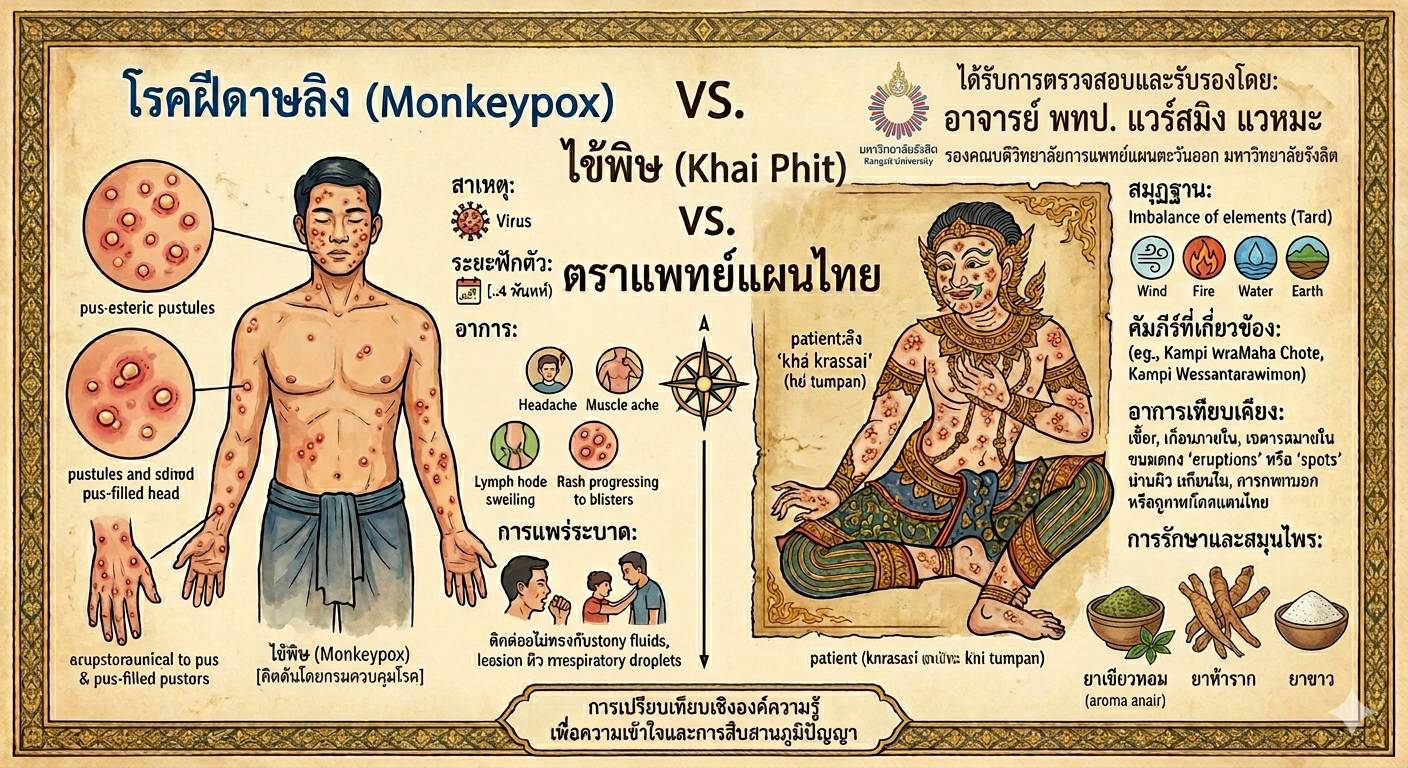
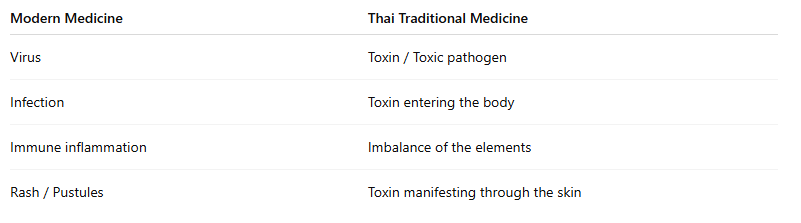
Comparative Table of Concepts Between the Two Medical Systems
To better understand the disease mechanism of monkeypox, the conceptual framework of modern medicine can be compared with Thai traditional medicine as follows:
Thai Traditional Medicine Approach to Care and Treatment
When dealing with conditions classified as toxic fever or black fever, the key principles are to “expel the fever toxin” and “cool down toxic heat” in order to prevent the toxin from retreating deeper into the body.
Traditional Thai herbal formulations, including aromatic preparations and antipyretic remedies listed in Thailand’s National List of Essential Medicines, are commonly used for symptomatic care. Examples include:
๐ Ya Khiao Hom: Traditionally used to reduce toxic heat, relieve fever toxins, and help bring out rashes or eruptions such as measles-like lesions in a systematic manner.
๐ Ya Ha Rak (Benchalokawichian): A well-known traditional antipyretic formulation used to relieve fever, body heat, and various types of fever toxins.
๐ Ya Khao: A cooling remedy used to reduce fever, clear toxic heat, and relieve internal inflammation.
Conclusion
Although modern medicine and Thai traditional medicine use entirely different conceptual frameworks and terminology, when considered in terms of symptoms, disease progression, and epidemiology, the two systems show a surprisingly meaningful alignment.
From the Thai traditional medicine perspective, monkeypox can be understood as a condition in which a “toxic pathogen” disturbs the body’s elements and blood, causing imbalance. Integrating knowledge from both medical systems not only broadens our understanding of the disease but also provides additional perspectives for care, treatment, and health recovery.
Compiled and disseminated by:
Waesaming Waehama, ATTM
Deputy Dean, College of Oriental Medicine
Rangsit University
Reference : ArokaGO Health Library Symptoms Monkeypox
Thai Medical and Wellness Tourism Association (TMWTA)
Share this article
More Articles
Discover more insights on health care and medical tourism.

Middle Ear Infection
A middle ear infection occurs when the tissues inside the middle ear become inflamed. Fluid or pus may accumulate behind the eardrum, leading to symptoms such as:

Lower Back Pain
Lower back pain is a common condition that can affect people of all ages and genders, particularly working-age adults. Symptoms may range from mild discomfort to severe pain that interferes with work, sleep, movement, and overall quality of life.

RIRS for Kidney and Ureteral Stones
RIRS stands for Retrograde Intrarenal Surgery. It is a minimally invasive procedure used to treat kidney stones and stones in the upper ureter without making an external surgical incision.