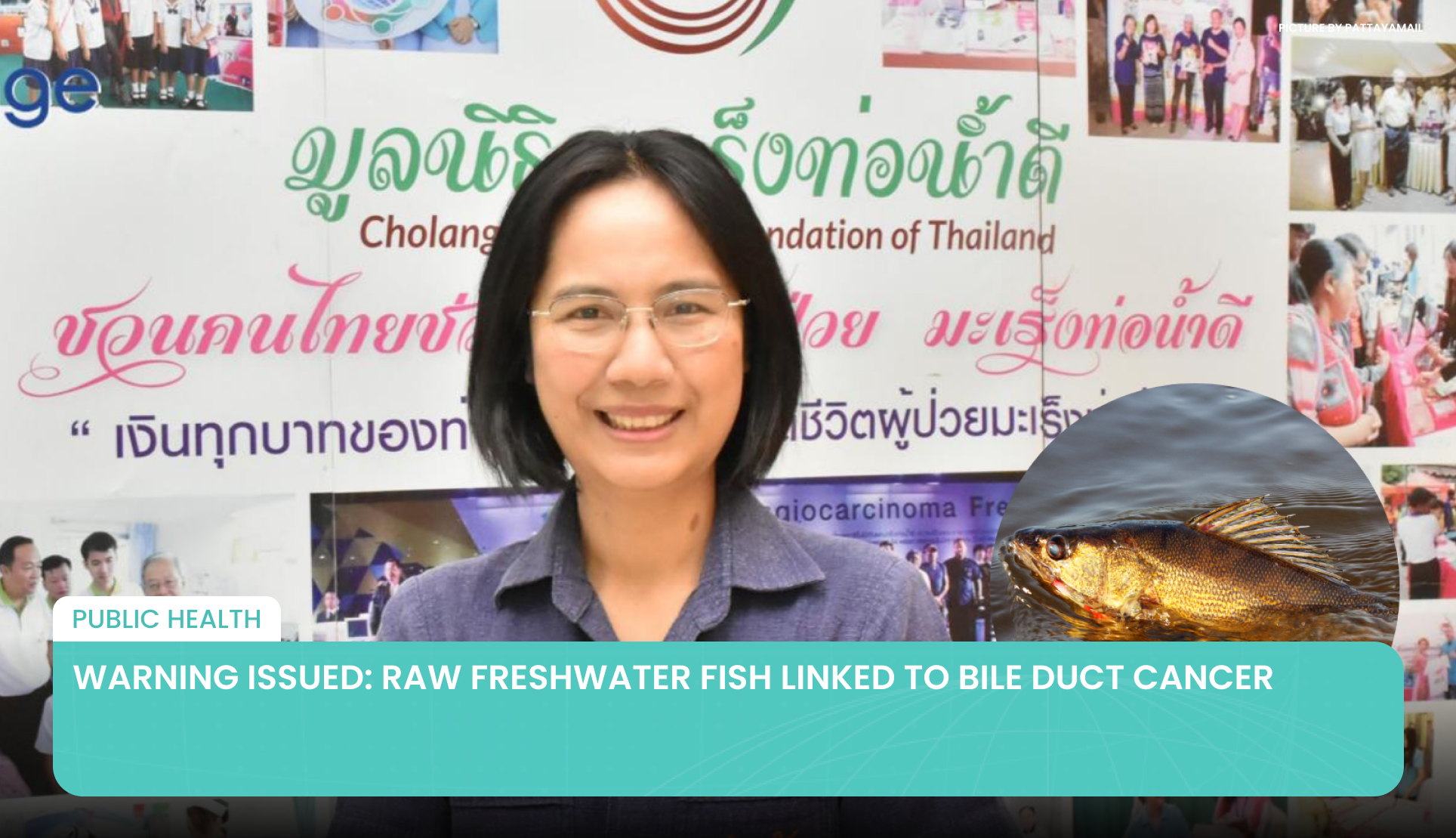
Warning Issued: Raw Freshwater Fish Linked to Bile Duct Cancer
The Cholangiocarcinoma Research Institute (CARI) has issued a public health warning urging people to avoid consuming raw freshwater fish, even if screening with the OV-ATK rapid test shows no infection or after receiving treatment for liver fluke infestation. The warning aims to prevent reinfection with liver flukes, a major cause of cholangiocarcinoma (bile duct cancer). The institute also recommends that people aged 15 and above undergo annual screening, which is available free of charge.
The Cholangiocarcinoma Research Institute (CARI) has issued a public health warning urging people to avoid consuming raw freshwater fish, even if screening with the OV-ATK rapid test shows no infection or after receiving treatment for liver fluke infestation. The warning aims to prevent reinfection with liver flukes, a major cause of cholangiocarcinoma (bile duct cancer). The institute also recommends that people aged 15 and above undergo annual screening, which is available free of charge.
On December 7, 2025, Assoc. Prof. Dr. Watcharin Loilome, Director of the Cholangiocarcinoma Research Institute at Khon Kaen University and Secretary-General of the Cholangiocarcinoma Foundation, stated that although most at-risk individuals tested with the OV-ATK rapid liver fluke test may show negative results, and even those who test positive and receive deworming treatment, the risk remains high if they return to eating raw freshwater fish. Such behavior can lead to rapid reinfection. Repeated infections significantly increase the likelihood of chronic inflammation of the bile ducts, which can ultimately develop into cholangiocarcinoma, a cancer that claims many Thai lives each year—particularly in the Northeastern region (Isan), where incidence rates are notably high.
Cholangiocarcinoma and liver cancer continue to be major public health concerns in Thailand and are among the leading causes of cancer-related deaths, especially among men, where these cancers rank as the most common. Data indicate that 70–80% of liver cancer cases in Northeastern Thailand are cholangiocarcinoma, clearly reflecting the ongoing widespread transmission of liver fluke infection. In many areas, people continue to consume raw or undercooked freshwater fish dishes such as larb pla (raw fish salad), koi pla, pla som (fermented fish), or pla ra (fermented fish sauce) produced through accelerated, non-standard processes.
“The World Health Organization has confirmed that liver fluke infection is a major cause of cholangiocarcinoma,” Dr. Watcharin emphasized. “However, many people mistakenly believe that parasitic infection is minor, or that a single course of deworming guarantees lifelong safety. This dangerous misconception must be urgently corrected.”
Dr. Watcharin further explained that a negative OV-ATK result only reflects the individual’s current status and does not guarantee future protection. Continued high-risk behavior can result in second or third infections, which are even more dangerous. With each reinfection, the body mounts a faster and more severe inflammatory response, repeatedly damaging bile duct cells. Over time, this damage can lead to genetic mutations and the development of cholangiocarcinoma. The disease is particularly dangerous because early-stage infection and even early-stage cancer often present no symptoms, causing many patients to seek medical care only when severe symptoms appear—such as jaundice, chronic abdominal pain, unexplained weight loss, or pale stools—by which time the disease is advanced, difficult to treat, and associated with high mortality.
Traditional diagnosis through stool examination has low sensitivity, as many infected individuals carry a small number of parasites, resulting in false-negative findings. In contrast, the OV-ATK rapid test, which detects infection via urine samples, enables faster and more accurate screening, with results available within 5–10 minutes.
“Screening conducted in Northeastern Thailand using OV-ATK revealed infection rates as high as 25%, or one in four people,” Dr. Watcharin noted. “This is a clear signal that the situation remains severe and that screening must be expanded to cover more at-risk populations.”
He stressed that whether individuals test negative or have already received treatment, the most critical measure is to never return to eating raw freshwater fish, as reinfection poses the greatest risk for developing cholangiocarcinoma. The institute recommends the following strict preventive measures:
1. Completely avoid all raw freshwater fish, particularly cyprinid species such as minnows and silver barb.
2. Avoid short-fermented or non-standard pla som and pla ra products.
3. Undergo liver fluke screening annually, especially for those with a history of high-risk behavior. Under Thailand’s universal health coverage schemes (Gold Card, Social Security, and Civil Servant Medical Benefits), all Thai citizens aged 15 and above who are at risk are entitled to one free screening per year.
4. Individuals aged 40 and above with risk factors are advised to undergo annual ultrasound screening for cholangiocarcinoma.
Dr. Watcharin concluded that addressing liver fluke infection requires multi-sectoral cooperation, including screening, treatment, public education, and upstream risk management—such as hygienic production of fermented fish products and proper waste management—to prevent parasites from re-entering water sources and re-infecting humans.
For the public, he reiterated that early detection, timely treatment, and permanent behavioral change—particularly avoiding raw freshwater fish—are key to reducing the risk of liver fluke infection and cholangiocarcinoma. This is a preventable threat that everyone can address through informed and responsible choices.
Source: www.thaihealth.or.th
此类别中的文章由我们的编辑团队撰写,旨在让您了解最新的医疗保健和医疗旅游新闻。