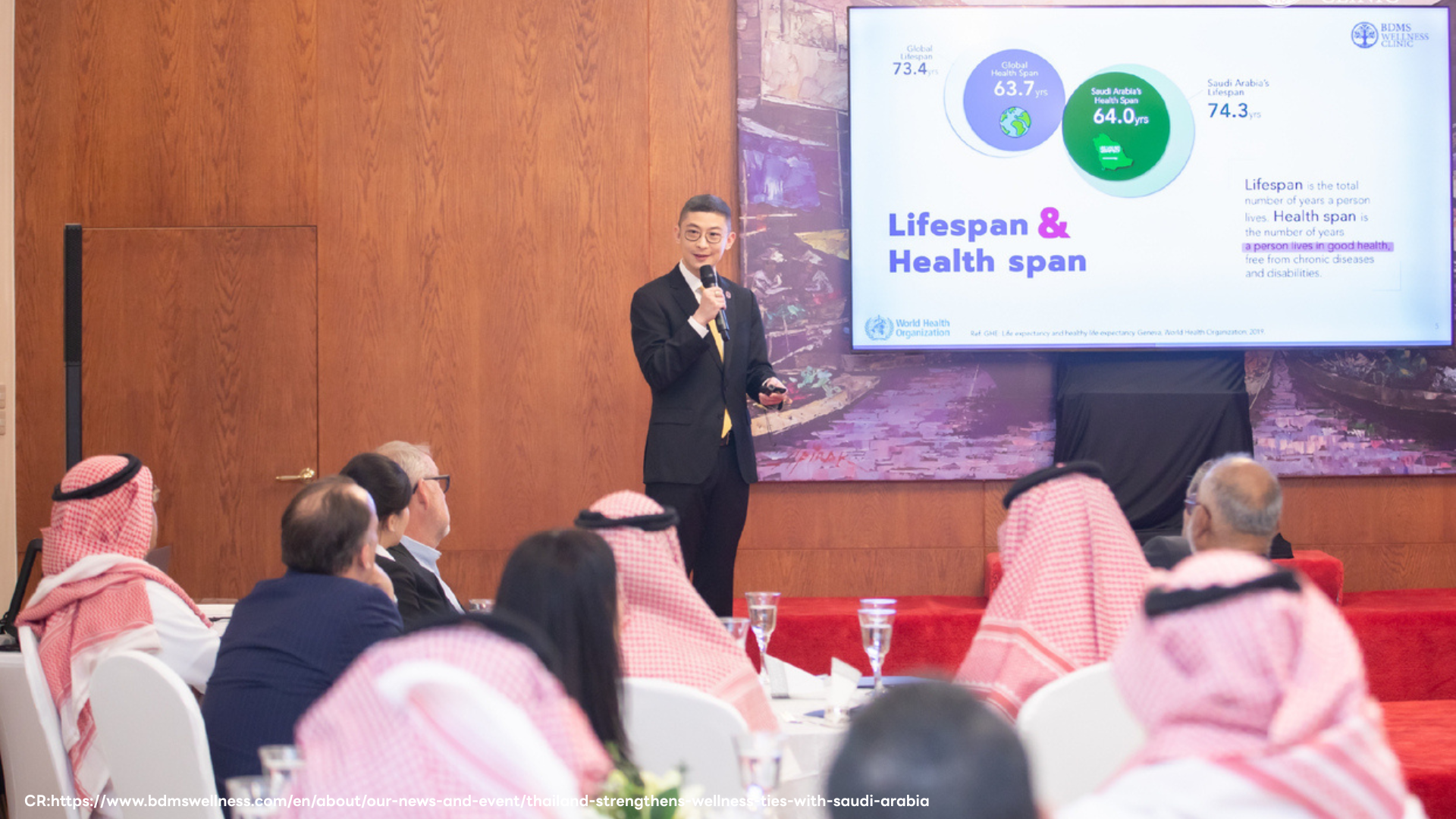
Bangkok, Thailand – May 21, 2025 – Marking a significant step in building international health networks, a leading Thai wellness executive was invited by the Royal Thai Embassy in Riyadh, Kingdom of Saudi Arabia, to lead the Thai delegation in sharing knowledge on holistic healthcare under the concept of Scientific Wellness. The academic seminar, titled “Wellness Hub Thailand: The Future of Global Wellness,” aligns with Saudi Arabia’s national development strategy, Saudi Vision 2030, which emphasizes enhancing healthcare systems and improving quality of life. The presentation also highlighted Thailand’s soft power in the field of health, reinforcing the country’s vision and determination to become a global leader in wellness tourism. The event was honored by the presence of the Thai ambassador to Saudi Arabia and distinguished guests from various sectors in the Kingdom, reflecting a shared commitment to advancing health cooperation between the two nations.
In an effort to strengthen health collaboration between Thailand and Saudi Arabia, a Thai delegate participated in the seminar and delivered a keynote presentation advocating for the Wellness Hub Thailand model. The approach emphasizes holistic and preventive healthcare through the principles of Scientific Wellness, responding to modern lifestyles and aiming to improve the quality of life at both national and global levels. This seminar, officially opened by the Thai ambassador in Riyadh, served as a meaningful platform to promote regional health networks.
This exchange represents a major milestone in expanding bilateral cooperation aligned with Saudi Vision 2030, which aims to sustainably develop the country’s health system and promote investment in healthcare services and wellness tourism. The Wellness Hub Thailand initiative not only demonstrates Thailand’s potential to become a global wellness tourism destination but also initiates tangible policy linkages between both countries. Academic collaboration and health knowledge exchange serve to elevate Thailand as the Wellness Destination of the World, while simultaneously supporting Saudi Arabia’s objective to improve long-term national health outcomes.
Despite extended global lifespans, the number of years people live in good health has not increased at the same rate. According to the World Health Organization (WHO), the average global lifespan increased from 66.8 years in 2000 to 73.4 years in 2019, thanks to advances in medical treatment and healthcare access. However, the average health span—meaning years lived in good health without illness or disability—remains at just 63.7 years, indicating that many people spend over a decade of their lives in poor health.
This health gap is similarly present in Saudi Arabia. WHO’s 2019 data shows that the average lifespan in Saudi Arabia is 74.3 years, while the health span is only 64 years, meaning that many people live with chronic illness for approximately 10.3 years before the end of life.
A major cause of this issue is the rise of non-communicable diseases (NCDs), which typically increase with age. As the world transitions into an aging society, NCDs have emerged as a global silent threat. WHO reported in 2022 that over 45 million people worldwide died from NCDs, highlighting a challenge faced by all nations. In Saudi Arabia, the situation is equally concerning, with 73% of annual deaths—approximately 105,200 lives or 12 people every hour—attributed to NCDs. The leading causes include cardiovascular diseases, cancer, chronic respiratory conditions, and diabetes.
Another pressing issue in Saudi Arabia is the high prevalence of overweight and obesity. WHO’s 2022 report indicated that over 73% of the population, or around 25 million people, are overweight or obese. This condition is directly linked to the development of multiple NCDs and increases the risk of severe illness or death, particularly during health crises such as the COVID-19 pandemic. Research shows that people with high blood pressure face double the risk, while those with heart disease or diabetes face triple the risk. Individuals with a history of stroke face four times the risk, and those with obesity have a sevenfold increased risk of death compared to the general population.

With a strong vision to position Thailand as the Wellness Destination of the World, Thai representatives have continued to collaborate with both public and private sectors to promote preventive medicine through Scientific Wellness. This proactive approach is at the heart of efforts to enhance Thailand’s role as a global Wellness Hub, offering high-quality healthcare services to people from all over the world. The recent visit to the Royal Thai Embassy in Riyadh marks another meaningful step in strengthening Thailand’s global health network and expanding its wellness opportunities on the international stage.
Thailand’s unique strengths make it an attractive destination for global wellness travelers. Its rich natural geography, including scenic beaches, lush forests, and mountainous terrain, offers the perfect environment for rest and rejuvenation. The country’s vibrant culture and long-standing traditions reflect a deep historical identity, while Thai cuisine, celebrated for its flavor and originality, continues to captivate international visitors.
In the field of healthcare, Thailand is globally recognized for its traditional wisdom, including herbal medicine and Thai traditional healing practices. These are highly regarded for their ability to promote health and restore the body. Cultural assets such as Thai massage and the Thai spa industry have become prominent features, blending ancient healing arts with mind-body-spirit relaxation, all delivered with internationally recognized service standards.
Furthermore, Thailand’s advancement in modern medical technologies and its skilled healthcare professionals significantly strengthen the country’s capacity to provide excellent health services. By seamlessly integrating tourism, nature, culture, and healthcare, Thailand is able to offer comprehensive wellness experiences that meet the needs of international travelers seeking both relaxation and recovery. These combined factors position Thailand as a rising global Wellness Hub, offering not just memorable experiences but also exemplifying leadership in sustainable healthcare and improved quality of life for people around the world.
Source:
此类别中的文章由我们的编辑团队撰写,旨在让您了解最新的医疗保健和医疗旅游新闻。