DXA Bone Density Scan: A Guide to Osteoporosis Screening in Thailand

Osteoporosis is often called a “silent disease” because it can develop gradually without noticeable symptoms. Many people remain unaware that their bones have become weaker until they experience a fracture, particularly in the hip, spine or wrist.
As people age, bone density and bone quality may decline, increasing the risk of fractures even after minor accidents, such as falling from standing height.
A DXA bone density scan is an important diagnostic tool that helps healthcare professionals identify low bone density, diagnose osteoporosis, assess fracture risk and monitor treatment outcomes.
For individuals considering preventive healthcare or healthy aging services in Thailand, understanding bone health can be an important part of long-term wellness planning.
What Is a DXA Bone Density Scan?
Dual-energy X-ray absorptiometry (DXA), also commonly known as a DEXA scan, is a medical imaging technique that uses two different X-ray energy levels to measure bone mineral density (BMD).
Bone mineral density is generally reported in grams per square centimeter (g/cm²).
Central DXA is widely regarded as the gold standard for measuring bone mineral density and diagnosing osteoporosis in appropriate patient populations.
| DXA Scan at a Glance | Details |
|---|---|
| Procedure Duration | Approximately 10–30 minutes |
| Procedure Type | Non-invasive medical imaging |
| Radiation Exposure | Very low |
| Anesthesia | Not required |
| Fasting | Generally not required |
| Primary Purpose | Bone density measurement and fracture risk assessment |
Why Is Bone Density Testing Important?
A DXA scan can provide valuable information about bone health before a fracture occurs.
Healthcare professionals may recommend bone density testing to:
- Identify low bone mass (osteopenia) and osteoporosis.
- Assess the likelihood of future fractures.
- Determine whether osteoporosis medication may be appropriate.
- Develop an individualized bone health management plan.
- Monitor changes in bone density over time.
- Evaluate the response to osteoporosis treatment.
Early identification of bone loss can support timely intervention and help reduce the risk of osteoporosis-related complications.
Which Parts of the Body Are Examined During a DXA Scan?
Central DXA primarily measures bone mineral density in the lumbar spine and hip. The forearm may also be examined under specific clinical circumstances.
| Measurement Site | Clinical Importance |
|---|---|
| Lumbar Spine (L1–L4) | Assesses bone loss and helps monitor treatment response. |
| Hip (Femoral Neck and Total Hip) | Provides important information for evaluating hip fracture risk. |
| Forearm (33% Radius) | May be used when spine or hip measurements cannot be obtained or interpreted appropriately, or when specific clinical indications exist. |
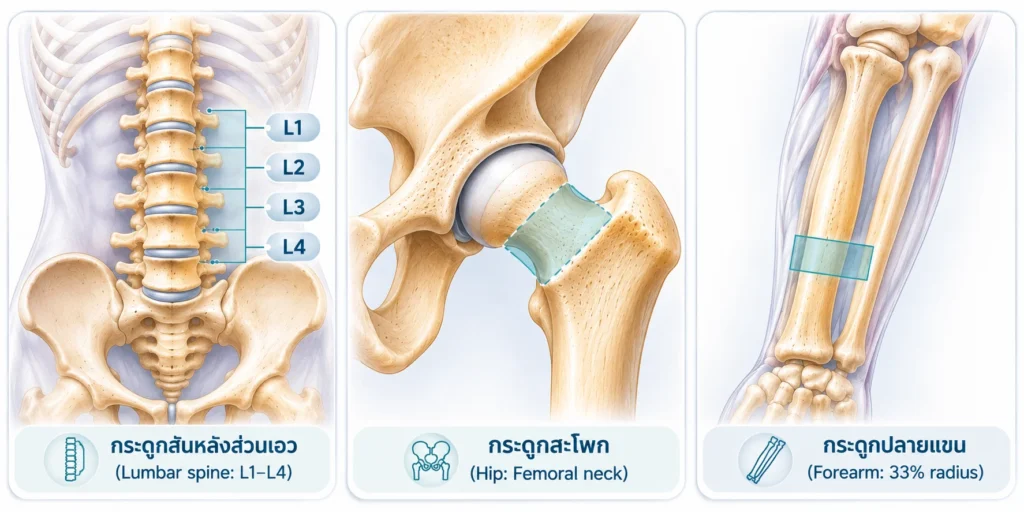
Common skeletal sites for DXA bone mineral density measurements.
Who Should Get a Bone Density Test?
According to the 2026 Thai Osteoporosis Foundation recommendations cited in the original article, bone density screening is recommended for the following groups.
| Population | Screening Recommendation |
|---|---|
| Women aged 65 and older | Bone density screening recommended |
| Men aged 70 and older | Bone density screening recommended |
| Postmenopausal women under 65 | Screening based on risk factors |
| Men aged 50–69 | Screening based on risk factors |
Common Risk Factors for Osteoporosis
- Previous fractures resulting from minor trauma, such as a fall from standing height.
- Parental history of hip fractures.
- Early menopause before the age of 45 or surgical removal of both ovaries.
- Prolonged estrogen deficiency.
- Long-term corticosteroid use.
- Certain breast or prostate cancer treatments that affect bone density.
- Smoking or excessive alcohol consumption.
- Low body weight or BMI below 20 kg/m².
- Significant loss of height.
- Evidence of low bone density or vertebral fractures on X-rays.
Individuals with an elevated fracture risk based on a clinical assessment, including the Fracture Risk Assessment Tool (FRAX), may also benefit from bone density testing.
How to Prepare for a DXA Bone Density Scan
A DXA scan generally requires minimal preparation. Patients are typically advised to follow these recommendations:
- Eat and drink normally, as fasting is generally not required.
- Avoid calcium supplements for at least 24 hours before the examination.
- Wear comfortable clothing without metal zippers, buttons or belts around the examination area.
- Inform healthcare professionals about recent imaging procedures involving contrast agents or radioactive tracers.
- Inform the healthcare provider if you are pregnant or suspect pregnancy.
- Bring previous DXA scan results, if available, for comparison.
What Happens During a DXA Scan?
During the examination, the patient lies flat on a padded examination table while a scanning arm passes over the area being examined.
The healthcare professional positions the patient appropriately to obtain accurate measurements of the spine, hip or other selected areas.
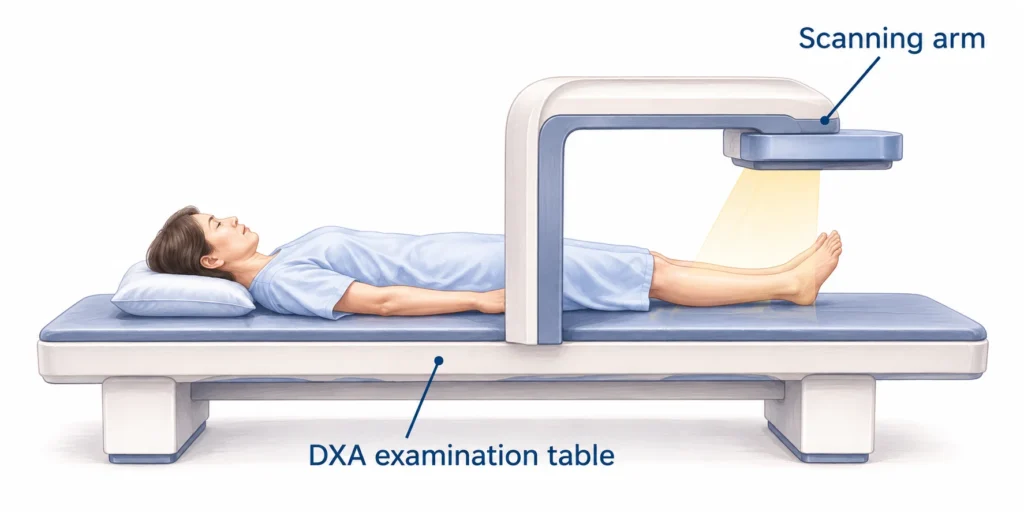
Illustration of a DXA bone density examination.
The procedure is generally painless, does not require injections or anesthesia, and typically takes approximately 10–30 minutes.
DXA uses a very low dose of X-rays, and no radiation remains in the body after the examination.
Understanding Your DXA Scan Results
A bone density report typically includes three important measurements: BMD, T-score and Z-score.
| Measurement | Meaning |
|---|---|
| BMD | The measured bone mineral density. |
| T-score | Compares bone density with that of a healthy young adult reference population. |
| Z-score | Compares bone density with an age- and sex-matched reference population. |
Understanding Your T-score
For postmenopausal women and men aged 50 and older, T-scores are generally used to classify bone mineral density.
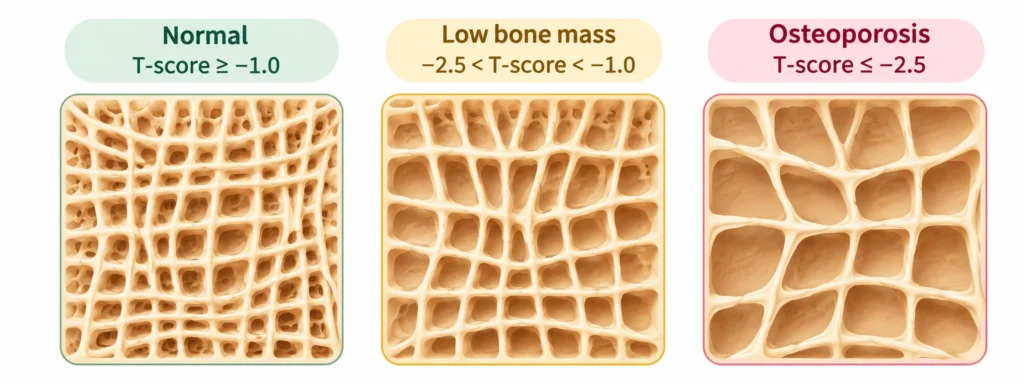
Illustrative comparison of bone structure and T-score classifications.
| Classification | T-score | Example |
|---|---|---|
| Normal Bone Density | −1.0 or higher | −0.5 |
| Low Bone Mass (Osteopenia) | Below −1.0 but above −2.5 | −1.8 |
| Osteoporosis | −2.5 or lower | −3.0 |
A more negative T-score indicates lower bone mineral density relative to the reference population.
Understanding Your Z-score
Z-scores are generally preferred for premenopausal women and men younger than 50.
A Z-score of −2.0 or lower indicates bone mineral density below the expected range for age and may require further investigation.
A low Z-score alone should not automatically be interpreted as a diagnosis of osteoporosis.
Can You Experience a Fracture Even with Normal Bone Density?
Yes. Bone strength depends on more than bone mineral density alone.
Bone quality, internal bone structure, age, medical conditions, medication use, previous fractures and the likelihood of falling can all influence fracture risk.
Healthcare professionals may use the Fracture Risk Assessment Tool (FRAX) alongside DXA results to estimate the 10-year probability of hip fractures and major osteoporotic fractures.
Additional spinal imaging or Vertebral Fracture Assessment (VFA) may also be recommended when vertebral fractures are suspected.
How Often Should You Have a DXA Scan?
Patients receiving osteoporosis treatment may undergo follow-up bone density testing every one to two years.
However, the appropriate screening interval varies depending on age, initial bone density, medical history, fracture risk and treatment.
Whenever possible, follow-up examinations should be performed using the same DXA machine to improve the reliability of comparisons.
Small changes in bone mineral density may reflect measurement variability rather than actual bone loss or improvement. Results should therefore be interpreted by a qualified healthcare professional.
What Should You Do If You Have Low Bone Density?
A diagnosis of low bone density or osteoporosis does not necessarily mean that a fracture is inevitable.
An individualized bone health management plan may include:
- Adequate calcium, vitamin D and protein intake.
- Appropriate weight-bearing exercises.
- Muscle-strengthening activities and balance training.
- Smoking cessation and limiting alcohol consumption.
- Home modifications to reduce the risk of falls.
- Prescription medication when clinically indicated.
- Regular medical follow-up and bone health monitoring.
Regular medical follow-up is important for evaluating treatment response and maintaining long-term bone health.
Bone Density Testing and Preventive Healthcare in Thailand
Bone health assessment can be particularly relevant for older adults, postmenopausal women and individuals interested in preventive healthcare and healthy aging.
When considering a DXA scan in Thailand, international patients may wish to evaluate the following factors:
- Availability of central DXA technology.
- Access to qualified medical professionals.
- Appropriate interpretation of bone density results.
- Availability of English-language consultations.
- Access to osteoporosis management and follow-up care.
Through ArokaGO, international patients can explore healthcare providers and contact them directly to learn more about available diagnostic services, osteoporosis assessments and personalized healthcare options in Thailand.
Frequently Asked Questions (FAQs)
Is a DXA scan painful?
No. A DXA scan is a non-invasive imaging procedure that generally does not cause pain or require anesthesia.
What is the difference between DXA and DEXA?
DXA and DEXA refer to the same bone density measurement technology: dual-energy X-ray absorptiometry.
Is a DXA bone density scan safe?
DXA uses a very low dose of ionizing radiation. Patients should inform their healthcare provider if they are pregnant or suspect pregnancy.
Do I need to fast before a bone density test?
Fasting is generally not required. However, patients are typically advised to avoid calcium supplements for at least 24 hours before the examination.
What T-score indicates osteoporosis?
A T-score of −2.5 or lower is consistent with osteoporosis when measured at an appropriate skeletal site in postmenopausal women and men aged 50 and older.
Can osteoporosis be detected before symptoms appear?
Yes. DXA can identify reduced bone mineral density before noticeable symptoms or fractures develop.
Do I need a bone density scan every year?
Not necessarily. The recommended testing interval depends on individual fracture risk, previous results and treatment status.
Can international patients get a DXA scan in Thailand?
International patients can inquire about DXA scanning at hospitals and diagnostic centers in Thailand. Availability, consultation languages and examination fees vary between healthcare providers.
Conclusion
A DXA bone density scan is an important tool for identifying osteoporosis, assessing fracture risk and monitoring bone health.
Early assessment, appropriate lifestyle changes and individualized medical care can help support mobility, independence and long-term quality of life.
The ultimate goal of osteoporosis screening is not simply to improve bone density measurements, but to help prevent fractures and maintain healthy, active aging.
Discover healthcare and preventive wellness options in Thailand with ArokaGO — Your Gateway to World-Class Thai Healthcare.
Medical Disclaimer: This article is intended for general educational purposes and should not replace professional medical advice, diagnosis or treatment.
References
Adapted by ArokaGO from Doctor Wat — Bone Mineral Density Assessment Using DXA
International Society for Clinical Densitometry (ISCD). 2023 ISCD Official Adult Positions.
Radiological Society of North America (RSNA) and American College of Radiology (ACR). Bone Density Scan (DEXA or DXA).
Thai Osteoporosis Foundation (TOPF). Clinical Practice Guidelines for Osteoporosis Management, 2026.
Police General Hospital
Share this article
More Articles
Discover more insights on health care and medical tourism.

Does Age Matter More Than the Clinic in IVF?
Age is the factor that moves national IVF success rates the most, and the age that counts is the age of the eggs. The clinic matters too, but it cannot undo egg age. In the latest final US national report, covering IVF cycles started in 2023, 53.2% of planned egg collections in women under 35 led to a live birth. Over 42, the figure was 4.1% (SART National Summary Report, 2023).

Are Black Grooves on Your Teeth a Sign of Tooth Decay?
Some black marks are simply stains trapped in the natural grooves of the teeth, while others may indicate early dental cavities that require treatment.

Home Teeth Whitening: How It Works
Teeth whitening has become a popular cosmetic dental treatment for individuals who want to improve the appearance of discolored or yellowish teeth. One convenient option is home bleaching, which allows individuals to whiten their teeth at home under the guidance of a dentist.