
PRK (Photorefractive Keratectomy) Service
Complete service information and details
Description
PRK (Photorefractive Keratectomy) Service – Eye Bangkok Hospital
PRK is a laser vision correction procedure designed to treat myopia (nearsightedness), hyperopia (farsightedness), and astigmatism, helping patients achieve clearer vision with less dependence on glasses or contact lenses.
PRK is widely chosen by people who require high mobility such as pilots, police officers, military personnel, and athletes and it can be a valuable option for patients with thin corneas or those who may not be suitable for flap-based LASIK.
What is PRK?
PRK (Photorefractive Keratectomy) reshapes the cornea directly on the corneal surface so that light can focus more accurately on the retina.
Unlike LASIK, PRK does not create a corneal flap. Instead, the outermost corneal layer is gently removed, and an Excimer Laser is used to reshape the cornea. A special therapeutic contact lens is then placed temporarily to protect the eye during healing.
Who is PRK suitable for?
- Patients with myopia/hyperopia/astigmatism seeking long-term correction
- Individuals with active lifestyles (pilots, police, military, athletes)
- Patients with thin corneas or limitations for LASIK
- Those who prefer a flap-free laser procedure
Eligibility is confirmed through a comprehensive eye examination.
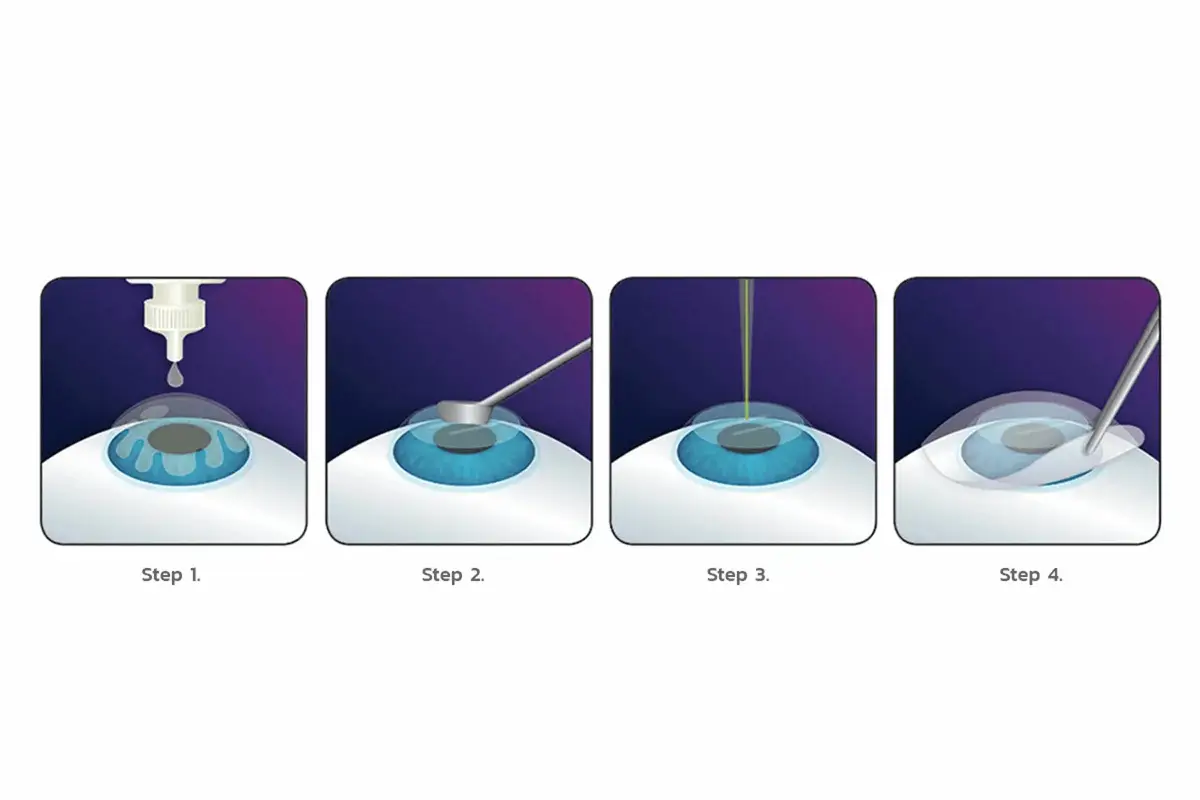
PRK Procedure Overview
1) Pre-operative assessment & preparation
- Detailed eye evaluation (refraction, vision testing, eye pressure, corneal curvature/thickness, retinal assessment)
- Stop wearing contact lenses for at least 7 days (or longer depending on lens type)
- Plan for recovery time, typically 5–7 days off work
- Arrange someone to accompany you on surgery day
- Avoid makeup, hair products, and perfume; bring sunglasses
2) The procedure
- Numbing eye drops are applied
- The corneal surface layer is removed (method chosen by the surgeon)
- The cornea is reshaped using an Excimer Laser
- A protective therapeutic contact lens is placed for about one week
- The procedure typically takes 10–15 minutes per eye
3) Post-operative care
- Use prescribed eye drops and artificial tears as directed
- Avoid rubbing the eyes and protect the eye with an eye shield as advised
- Avoid water/sweat/dust/smoke exposure during the early healing period
- Rest your eyes, especially during the first 24 hours
- Wear sunglasses to protect from UV light
Recovery Timeline
Recovery usually takes 1–3 weeks, and may be longer than some other laser procedures:
- Day 1: irritation, tearing, light sensitivity may occur
- Week 1: vision may be blurry or fluctuate
- Weeks 2–3: vision gradually improves and stabilizes
- 1–3 months: continued healing and follow-up visits to monitor recovery

Possible Risks & Side Effects
PRK is generally safe, but potential risks include:
- Dry eyes (often manageable with artificial tears)
- Temporary blurred vision, glare/halos in low light
- Corneal haze in some cases (more common with higher corrections or intense sun exposure)
- Infection (rare but important to monitor)
- Temporary increase in eye pressure due to certain medications (adjustable by your doctor)
Seek medical attention immediately if you experience severe pain, significant redness, discharge, or worsening vision.
Expected Outcomes
After full recovery, many patients achieve significantly clearer vision for both near and distance, with reduced dependence on glasses or contact lenses. Results may vary depending on individual eye conditions and healing response.
Overview
What's Included
- Initial Consultation
- Treatment Procedure
- Follow-up Care
- Medical Report
Pricing
Contact for pricing
Final price depends on your specific requirements
Tags
Contact Us
Reach out through any of these channels:
Provider Information

EYE BANGKOK HOSPITAL
Bangkok, Thailand

LASIK Service
LASIK Service – EYE BANGKOK HOSPITAL Permanent Vision Correction with Advanced Laser Technology LASIK at EYE BANGKOK HOSPITAL provides a permanent sol

Femto LASIK Service
Femto LASIK Service – Eye Bangkok Hospital Blade-Free LASIK with High-Precision Laser Technology Femto LASIK is an advanced vision correction procedur

Implantable Collamer Lens (ICL) Service
Implantable Collamer Lens (ICL) Service – Eye Bangkok Hospital A Long-Term Vision Correction Option Beyond LASIK In addition to LASIK, ICL (Implantabl

Optical Center
Optical Center – Eye Bangkok Hospital Comprehensive Vision Care & Premium Eyewear Solutions The Optical Center at Eye Bangkok Hospital provides compre

Cataract Treatment Service
Cataract Treatment Center – Eye Bangkok Hospital Comprehensive Cataract Diagnosis & Advanced Surgical Care A cataract is a condition in which the eye’

Pinguecula Treatment Service
Pinguecula Treatment Service – Eye Bangkok Hospital Pinguecula is a degenerative condition of the conjunctiva (the white part of the eye), appearing a